
Author’s note:
A lot of our investors lost their hard-earned money by directly investing in stocks like Zomato, Paytm, Policybazar, etc. Even though the benchmarks have recovered but many of the individual stocks are still trading at a deep discount viz-a-viz their all-time highs. We thought of writing an article for such investors who are always in search of the next ‘multibagger’
Post the covid rally, the word ‘Multibagger’ was on every investor’s investment checklist. This is evident from the fact that google searches for the word ‘multi-bagger’ increased 400% from the pre-COVID level.
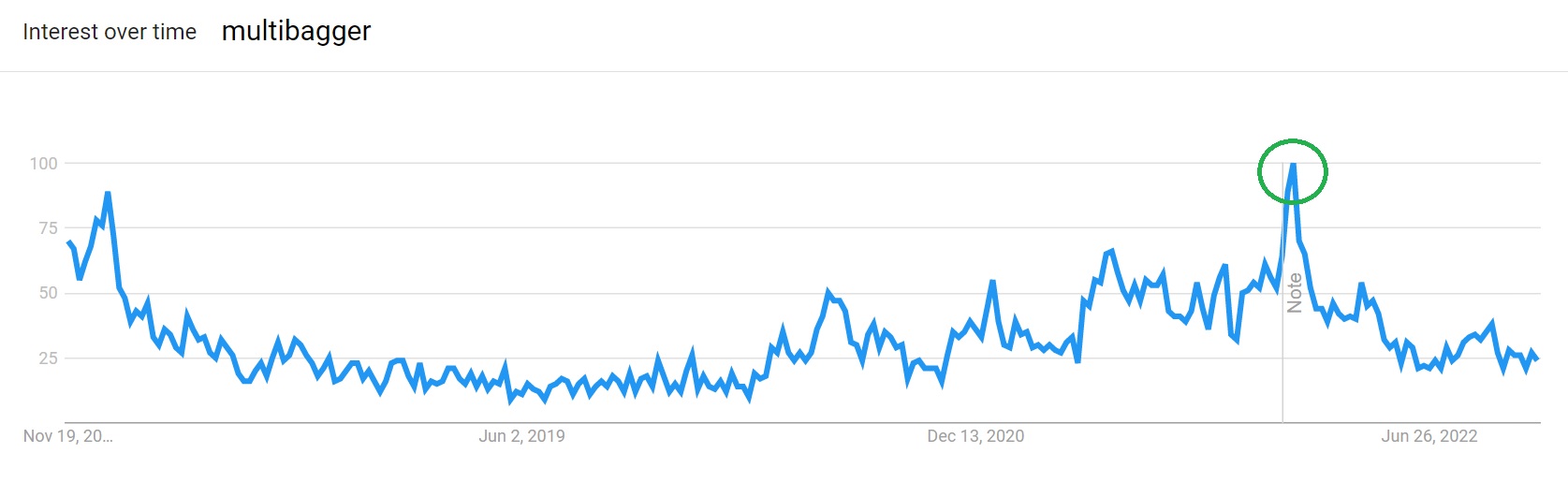
But the million-dollar question which needs to be answered is – have investors actually made any money by investing in these highly risky stocks?
1. What is a multi-bagger?
Investments that give returns that are several times their costs are called multi-baggers. As per Wikipedia, ‘A multi-bagger stock is an equity stock which gives a return of more than 100%’
The term ‘multi-bagger’ was coined by Peter Lynch in his 1988 book ‘One Up on Wall Street’ and comes from baseball where “bags” or “bases” that a runner reaches are the measure of the success of a play.
Multibaggers are usually smallcap stocks that have the potential to become midcaps or even large-caps over the period and hence, our article revolves around small-cap stocks only.
2. Why everyone wants to invest in multi-baggers?
Investors have always been attracted to such stocks by the possibilities of high returns in a relatively shorter period of time. Investors miss that every additional % of return comes with an additional risk which may not proportionately compensate for the higher returns.
3. Why small-cap investing is risky?
- Uncertainty of becoming multi-bagger;
- Low liquidity & manipulation by promoters/operators;
- Lack of data and history;
- Highly volatility
4. Direct equity vs mutual funds
An article was published in ‘The Mint’ on November 1, 2022, and the facts are presented as under:
- Almost 50% of the smallcap companies gave negative returns or stopped trading over the past 5 years. The number is much higher over the past 10 years;
- Just 6% of stocks turned multibaggers (>5X) over the past 5 years;
- Just 18% of the companies gave 2X to 5X returns over the past 5 years.
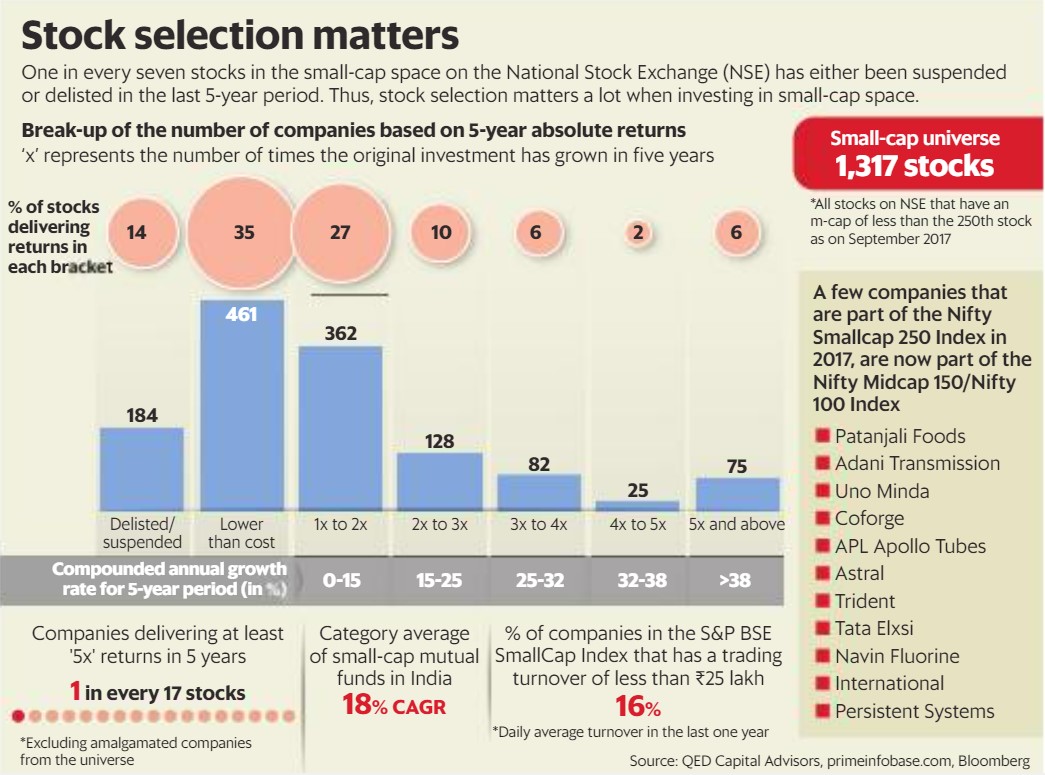
If we compare these figures with the small-cap mutual funds, the results are really impressive:
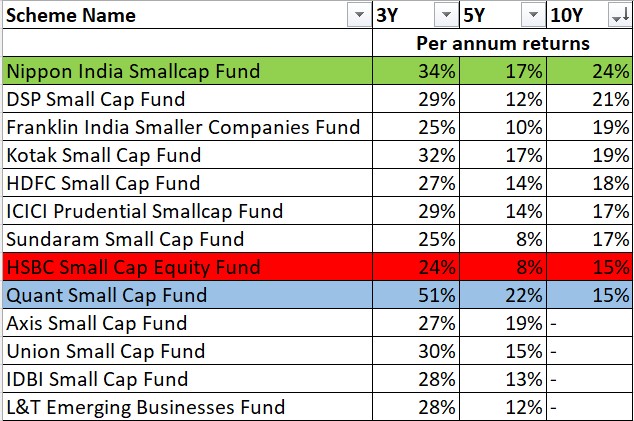
Even the worst-performing MF has given an annual return of 8% & 15% in the last 5 yrs & 10 yrs respectively. The best one has returned 22% & 24% annually in the same period. (Category average: 20% p.a. in last 10 years). A sum of 1 lac compounded at 20% p.a. for 10 yrs becomes 5.15 lacs 😀 (5X) – therefore, a multi-bagger!
‘NO SMALL CAP MUTUAL FUND HAS GIVEN A NEGATIVE RETURN IN THE LAST 3, 5 AND 10-YEAR PERIOD’ – This statement matches with our investment philosophy of ‘NEVER LOOSE CAPITAL’
Undoubtedly, the market would have been volatile during the above-mentioned periods as well but the probability of returns is much higher than investing directly in smallcap stocks. That is why it is recommended to keep a long-term time horizon when investing in small-cap stocks.
The verdict: If one has the time, means, and risk appetite to digest losses, one may choose the direct equity route but the majority of investors should invest only in an actively managed MF.
Disclaimer: The past performance may or may not sustain in the future. The views expressed herein constitute only the opinions and do not constitute any guidelines or recommendations on any course of action to be followed by the reader. This information is meant for general reading purposes only and is not meant to serve as a professional guide for the readers.
