
Allow me to introduce you to India’s unluckiest investor.
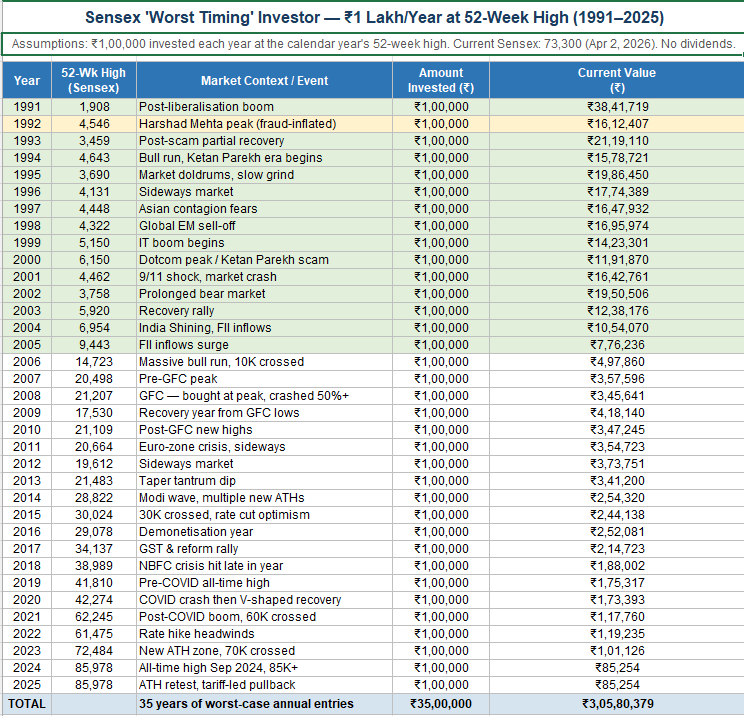
Every single year for 35 years — from 1991 to 2025 — he invested ₹1 lakh in the Sensex. Not on any random day. Not after careful research. He invested precisely at the 52-week high. The absolute worst moment every year, without exception.
He bought at the peak of the Harshad Mehta scam. He bought right before the Dotcom crash. He bought at the top of the 2008 bull run, just before the Sensex fell 50%+. He bought through demonetisation, the NBFC crisis, COVID, and rate hike cycles. Every year — worst timing, no exceptions.
His total investment over 35 years: ₹35 lakhs.
Current value: ₹3.05 crores.
That’s a ~10.5% CAGR — despite never once getting the timing right.
What this tells us is profound.
We spend enormous energy worrying about the right time to invest — waiting for a correction, hesitating after a run-up, second-guessing every market move. But this story makes a quiet, powerful argument: in the long run, when you invest matters far less than whether you stay invested.
Consider what staying invested through the decades actually meant:
– Surviving the Asian contagion scare of 1997
– Holding through 9/11 and a global market crash in 2001
– Not redeeming during the 50%+ Sensex fall in 2008–09
– Staying the course through COVID’s V-shaped panic in 2020
– Ignoring the noise of rate hikes and geopolitical shocks in 2022
At every one of these points, a rational, well-informed investor had strong reasons to exit. Our unlucky investor simply had no such instinct — and ended up 8.7x richer for it.
The real risk in equity investing is rarely the market. It’s the investor who exits at the bottom, waits on the sidelines, and misses the recovery that inevitably follows.
