Where Are My Returns?

Investors who entered the markets in the last 2 years have increasingly been asking the question — “Where are my returns?”


This concern is understandable, as the Nifty has largely been hovering in the 24,000–26,000 range for nearly two years despite multiple phases of volatility and global uncertainty.
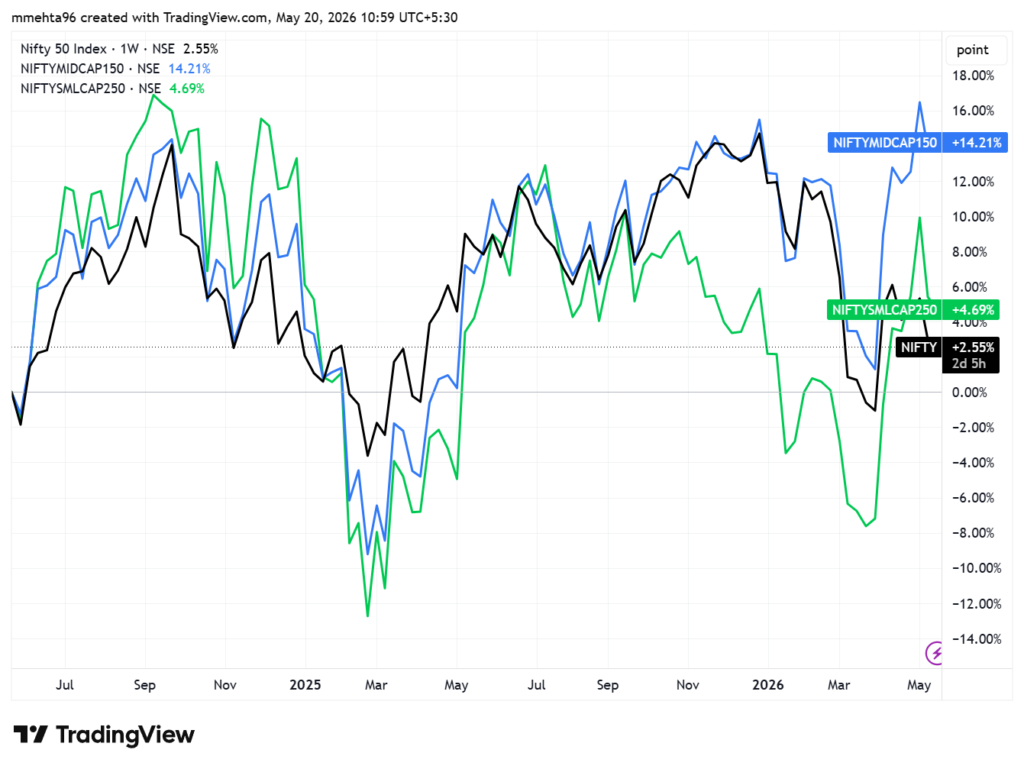
While such periods may feel unusual for first-time investors, market consolidation after strong rallies is a natural part of investing. Investors who have been through multiple market cycles over the last 5–10 years know that these phases often create the best opportunities to accumulate quality assets at reasonable valuations.


The global environment continues to remain uncertain with ongoing geopolitical tensions, trade disruptions, elevated interest rates, and slowing growth across major economies. However, despite these challenges, India continues to stand out relatively better due to strong domestic consumption, government spending, improving manufacturing ecosystem, stable banking system, and rising participation in financial markets.


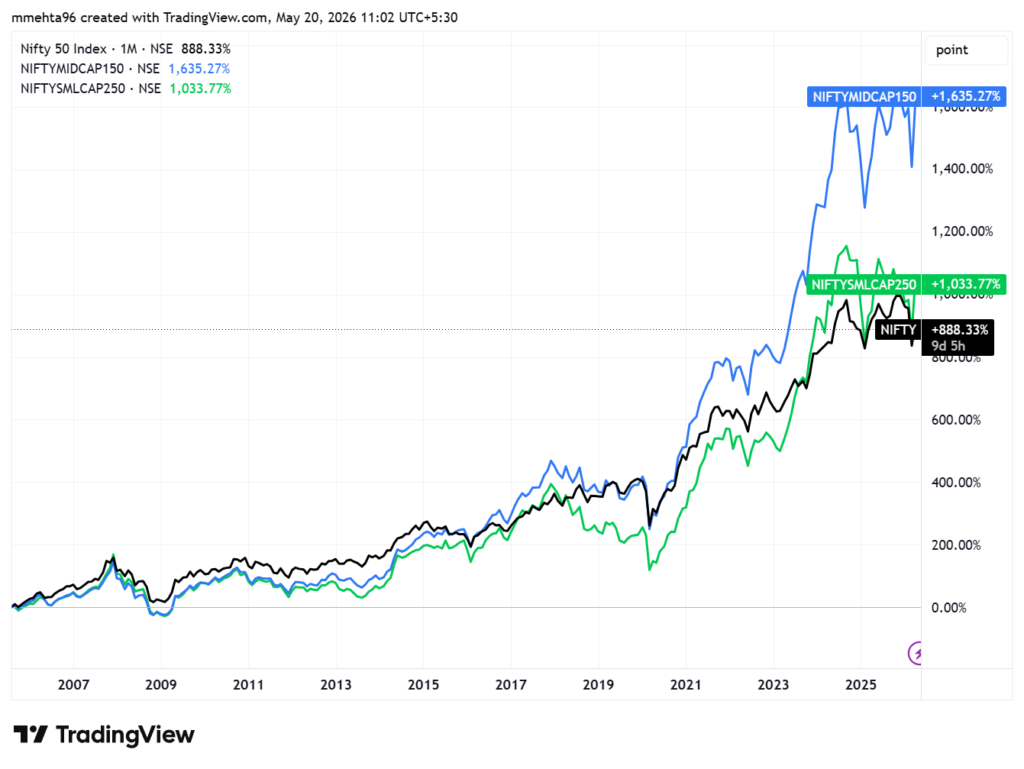
Historically, wealth creation in equities has not happened in a straight line. Markets often spend time consolidating before the next phase of growth begins. The first few years of investing may sometimes appear “boring,” but the real power of compounding becomes visible only over longer holding periods.
What Should Investors Do?

  • Continue SIPs with discipline and consistency.

  • Avoid panic during corrections and volatility.

  • If possible, consider averaging investments during meaningful market declines (10%–20% corrections).

  • Stay invested according to your long-term asset allocation strategy.

  • Avoid speculation, leverage, and short-term market predictions.

  • Focus on goals, not temporary market movements.


Equity investing is a long-term journey. Temporary periods of low returns are part of the process, but disciplined investors who stay invested through cycles are often the ones who benefit the most over time.
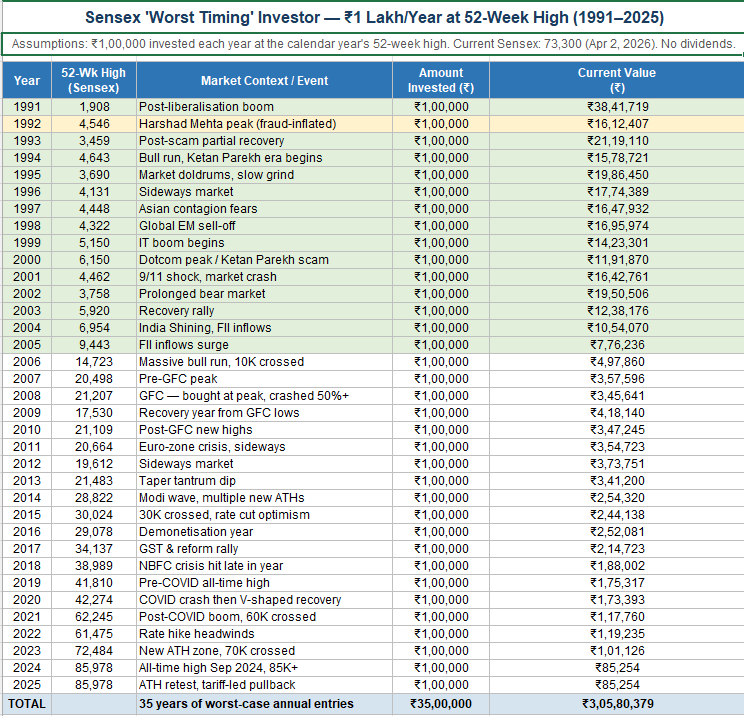
India’s unluckiest investor

Allow me to introduce you to India’s unluckiest investor.


Every single year for 35 years — from 1991 to 2025 — he invested ₹1 lakh in the Sensex. Not on any random day. Not after careful research. He invested precisely at the 52-week high. The absolute worst moment every year, without exception.


He bought at the peak of the Harshad Mehta scam. He bought right before the Dotcom crash. He bought at the top of the 2008 bull run, just before the Sensex fell 50%+. He bought through demonetisation, the NBFC crisis, COVID, and rate hike cycles. Every year — worst timing, no exceptions.


His total investment over 35 years: ₹35 lakhs.

Current value: ₹3.05 crores.

That’s a ~10.5% CAGR — despite never once getting the timing right.

What this tells us is profound.


We spend enormous energy worrying about the right time to invest — waiting for a correction, hesitating after a run-up, second-guessing every market move. But this story makes a quiet, powerful argument: in the long run, when you invest matters far less than whether you stay invested.


Consider what staying invested through the decades actually meant:

– Surviving the Asian contagion scare of 1997

– Holding through 9/11 and a global market crash in 2001

– Not redeeming during the 50%+ Sensex fall in 2008–09

– Staying the course through COVID’s V-shaped panic in 2020

– Ignoring the noise of rate hikes and geopolitical shocks in 2022


At every one of these points, a rational, well-informed investor had strong reasons to exit. Our unlucky investor simply had no such instinct — and ended up 8.7x richer for it.


The real risk in equity investing is rarely the market. It’s the investor who exits at the bottom, waits on the sidelines, and misses the recovery that inevitably follows.

Wills, Trusts and HUFs: Securing your legacy

You’ve worked hard to build your wealth — your home, your investments, your savings, your business. But here’s a question most people avoid: What happens to all of it when you’re no longer around?


Estate planning is not a topic reserved for the elderly or the ultra-wealthy. It is one of the most important financial decisions you can make — for yourself, and for the people you love. Today, we’d like to walk you through three powerful tools that can help you protect your wealth, reduce taxes, and ensure your family never has to fight over what you leave behind.

✍️ THE WILL — Your Final Word


A Will is a legal document in which you clearly specify who gets what after your lifetime. It is your voice when you are no longer present to speak.


Why is it important?

→ Without a Will, Indian succession laws (Hindu Succession Act / Indian Succession Act) take over — and the outcome may be very different from what you intended.

→ A Will prevents family disputes, lengthy court battles, and emotional suffering for your loved ones during an already difficult time.

→ It lets you decide who manages your estate, who takes care of your minor children, and how your assets are distributed — on your terms.

→ It can include specific instructions for sentimental assets like jewellery, property, or heirlooms that hold personal meaning.


Who should make a Will?


✔ Anyone who owns property — residential, commercial, or agricultural

✔ Anyone who has investments — mutual funds, stocks, FDs, insurance policies

✔ Parents of minor children who want to ensure their guardianship is secured

✔ Business owners who want a smooth and uncontested succession

✔ Anyone who wants to leave a specific legacy or charitable contribution


The hard truth: Even if you have a nominee in all your accounts, a nominee is only a caretaker — not the legal heir. Only a Will or succession law decides the final owner. Without a Will, your family may spend years in courts doing what could have been done in a day.

🏛️ THE TRUST — Wealth on Your Terms


A Trust is a legal arrangement where you transfer ownership of your assets to a Trustee, who manages them for the benefit of your chosen beneficiaries — as per your specific instructions.


Think of it as setting rules for how your wealth should be used, even decades after you’re gone.


Why is it important?

→ A Trust bypasses the lengthy and public probate process, ensuring your assets are distributed faster and privately.

→ It allows you to attach conditions to inheritance — for example, funds released to a child only at age 25, or only for education and medical needs.

→ Trusts protect assets from creditors, legal disputes, and financial mismanagement by heirs.

→ For families with members who have special needs or are financially dependent, a Trust ensures lifelong, structured financial support.

→ Private Trusts also offer significant estate and succession tax planning advantages for HNI families


Who should consider a Trust?

✔ High-net-worth individuals with assets across multiple categories — real estate, equity, business interests

✔ Parents of minor children or children who may not be financially mature

✔ Families caring for a differently-abled or dependent member

✔ Business families seeking structured generational wealth transfer

✔ Individuals who want to avoid family disputes over inheritance

✔ Philanthropists who want to create a lasting charitable legacy


A Trust is not just a legal document — it is a message to your family about your values, your intentions, and the life you want them to live.

🏠 THE HUF — A Smart Tax Structure for Families

A Hindu Undivided Family (HUF) is a unique legal and tax entity recognized exclusively under Indian law. When set up correctly, it allows a family to be treated as a separate taxpayer — independent from its individual members.


Why is it important?

→ An HUF gets its own PAN, its own tax slab, and its own ₹2.5 lakh basic exemption — entirely separate from your individual taxes.

→ Family income — rental income, business income, agricultural income, investments — can be routed through the HUF to significantly reduce the family’s overall tax outgo.

→ Assets gifted or inherited within the HUF are treated as HUF property, building a consolidated family wealth base.

→ The Karta (head of the HUF) manages affairs, while all family members remain co-parceners with defined rights.

→ It creates a formal legal structure for family wealth that supports long-term succession planning.


Who should consider an HUF?

✔ Any Hindu, Sikh, Jain, or Buddhist family (all are covered under HUF provisions)

✔ Families with rental income, agricultural income, or business income that can be legitimately split

✔ Families inheriting property or receiving gifts from relatives — these can be held by the HUF

✔ Individuals already in the 30% tax bracket looking to reduce personal tax liability legally

✔ Business families looking to separate personal and business wealth within a family structure


The best part? An HUF can be created at almost no cost, with just a deed and a PAN card — and the tax savings can run into lakhs annually.

🎯 SO, WHERE DO YOU BEGIN?

Every family’s situation is different. The right combination of a Will, a Trust, and an HUF depends on your asset profile, family structure, tax situation, and long-term goals.


At Onesta Capital Ventures, we help you go beyond just growing your wealth — we help you protect it and pass it on, seamlessly.


We’d love to schedule a conversation to assess your current estate planning structure and identify the opportunities most relevant to you.

The Cost of Retirement

What No One Tells You — Until It’s Too Late

The Retirement Conversation India Keeps Avoiding


Retirement is not an event. It is a state of financial independence that you either plan for — or stumble into unprepared. In India, we are good at planning weddings, children’s education, and home purchases.


But retirement? That conversation gets pushed to ‘later’. The problem with ‘later’ is that it is the most expensive word in personal finance.


This note is our attempt to change that conversation. We want to put hard numbers in front of you — not to alarm, but to empower. Because the best time to plan your retirement was the day you earned your first rupee. The second best time is today.

Reasons Why Retirement Planning is  Non-Negotiable?


1.  No Government Safety Net — You Are On Your Own

Unlike citizens of the UK, US, or Germany, the vast majority of Indians have no universal state pension or social security to fall back on. The EPFO covers organised-sector employees and the NPS exists — but the amounts they generate are rarely sufficient to maintain one’s pre-retirement lifestyle. The government cannot be your retirement plan. You must be your own retirement plan.

The Harsh Truth

Less than 12% of India’s workforce has access to any formal pension. The  remaining 88% must self-fund their entire retirement. That includes most  business owners, professionals, and self-employed individuals.

2.  Skyrocketing Healthcare Expenses

Medical inflation in India runs at 12–14% per annum — nearly double the general rate of inflation. As we age, healthcare consumption rises dramatically. A hospitalisation that costs ₹3 lakhs today will cost ₹30 lakhs in 20 years. Add to this chronic conditions, specialist consultations, home nursing, and long-term care — and healthcare alone can consume 25–35% of a retiree’s annual budget.

Key   Data Point

A couple retiring today at 60 may need ₹1–1.5 Crore earmarked purely for healthcare over their retirement years — even with health insurance. Post-retirement, insurers often restrict coverage or charge prohibitive premiums.

3.  Rising Life Expectancy — The Good Problem


India’s average life expectancy has risen from 59 years in 1990 to 70+ years today, and urban, educated, health-conscious individuals regularly live to 85–90. This is a triumph of medicine and nutrition. But financially, it is a challenge: you may need to fund 25–35 years of post-retirement life. Running out of money at age 80 is not a theoretical risk — it is a very real one for those who underestimate longevity.

Plan   For 90, Not 75

We always build retirement plans assuming a life expectancy of at least 85–90 years. It is far better to have surplus than to outlive your money.

4.  Inflation — The Silent Wealth Eroder

At a sustained 6% inflation, the value of money halves every 12 years. ₹1 lakh today will buy what ₹17,000 buys in 30 years. This means your retirement corpus cannot just be ‘large’ — it must be invested and growing even after retirement. A fixed deposit strategy post-retirement is a slow path to poverty. Your post-retirement portfolio must beat inflation consistently.

5.  The Death of Joint-Family Financial Support


For generations, Indian retirement relied on an implicit social contract: children would support ageing parents. That contract is rapidly breaking down. Nuclear families, children moving to different cities or countries, rising costs of living, and shifting social norms mean you cannot and should not build your retirement plan around financial support from your children. Expecting your children to fund your retirement is also an unfair burden on their financial journey.

6.  Lifestyle Inflation — You Won’t Want to ‘Cut Back’

Most people assume they will ‘live simply’ in retirement. The reality is often the opposite. With more time and fewer obligations, retirees tend to travel more, eat out more, pursue hobbies, and spend on grandchildren. A comfortable retirement is not a frugal one. Plan for the lifestyle you want — not a diminished version of it. Your retirement corpus must fund your aspirations, not just your survival.

7.  No Income, But Fixed Costs Remain

When you retire, your salary stops. But your EMIs, utility bills, maintenance costs, insurance premiums, and day-to-day expenses continue unabated. The shock of going from a monthly income to zero income — while expenses persist — is one of the most underestimated financial transitions. Without a well-structured retirement corpus and withdrawal plan, this transition can be deeply destabilising.

8.  Tax-Inefficient Withdrawal Without Planning

Unplanned retirement assets — lumped in FDs, real estate— often generate income that is fully taxable, leaving retirees in higher tax brackets than expected. Proper retirement planning involves not just accumulation, but structured, tax-efficient withdrawal. The right asset mix — equity mutual funds, debt funds, NPS, REITs — can dramatically reduce your post-retirement tax burden and extend corpus longevity.

Finding Your True Retirement Corpus — A Step-by-Step Framework

Most people guess a round number — ₹5 crore or ₹10 crore — and work backwards. That is the wrong approach. Here is the right one:

Step 1: Define Your Retirement Lifestyle

Start with today’s monthly expenses — not what you think you’ll spend in retirement, but what you spend right now. Be honest and comprehensive: rent or maintenance, groceries, utilities, dining, travel, medical, insurance, leisure, and charitable giving. This is your baseline.

      List all current monthly expenses in writing

      Add categories you currently don’t spend on but will (medical aids, leisure, travel)

      Deduct expenses that will stop (children’s education, EMIs that will end)

      Arrive at a realistic monthly retirement lifestyle number

Onesta Recommendation

Most of our HNI clients find their retirement monthly expense target is 70–90% of their current spending — not 50% as commonly assumed. Comfort does not shrink in retirement; it often expands.

Step 2: Adjust for Inflation — Find the Future Value of Monthly Expenses

The amount you need per month at retirement is NOT what you need today. You must project it forward at 6% annual inflation. Use this formula: Future Monthly Need = Current Monthly Expense × (1.06)^Years to Retirement

Example: If you need ₹1 lakh per month today and you retire in 25 years, you will need ₹4.3 lakhs per month at retirement just to maintain the same lifestyle. This step shocks most clients — but it is reality.

Step 3: Determine Your Retirement Duration

Calculate how many years your corpus must last. We recommend planning to age 90 as a minimum, and to age 95 for those with strong family longevity histories.


      Retiring at 50 → Plan for 40–45 years of post-retirement life

      Retiring at 60 → Plan for 30–35 years of post-retirement life

   Always err on the side of living longer — surplus is a gift, shortage is a catastrophe

Step 4: Calculate the Corpus — The Inflation-Adjusted Annuity Method


Your corpus must generate an income that keeps pace with inflation throughout your retirement. Using a 7% post-retirement portfolio return and 6% inflation, the ‘real’ return is approximately 1%. This gives us a corpus multiplier:

      Retiring at 50 (35-year retirement): Corpus ≈ 28× your annual expense at retirement

      Retiring at 60 (25-year retirement): Corpus ≈ 21× your annual expense at retirement

Formula: Corpus = (Monthly Expense at Retirement × 12) × Multiplier

Step 5: Account for Healthcare and Emergency Buffers

Add a dedicated healthcare and contingency reserve over and above the lifestyle corpus. We recommend ₹50 lakhs–₹1.5 crore for a couple depending on current health status, family medical history, and existing health coverage.

      Senior citizen health insurance (review coverage annually)

      Critical illness and personal accident covers

      ₹25–50 lakh liquid emergency fund separate from the retirement corpus

Step 6: Identify and Audit Existing Assets

Now inventory what you already have working towards retirement: existing mutual fund investments, PF and EPF balance, NPS Tier 1 corpus, LIC endowment maturity values, real estate rental income, and any other assets. Calculate their future value at your target retirement date assuming 10–12% growth for equity and 6–7% for debt assets.

Important Note

Do not count your primary residence as a retirement asset unless you genuinely plan to sell or reverse-mortgage it. Most people don’t — and shouldn’t be forced to.

Step 7: Identify the GAP — Then Bridge It

Gap = True Retirement Corpus Required minus Future Value of Existing Assets. This gap is what your systematic investments must fill. Now you know exactly what you need to save and invest every month — or as a lump sum today — to reach your retirement goal.

The Numbers: What You Need at Every Starting Age

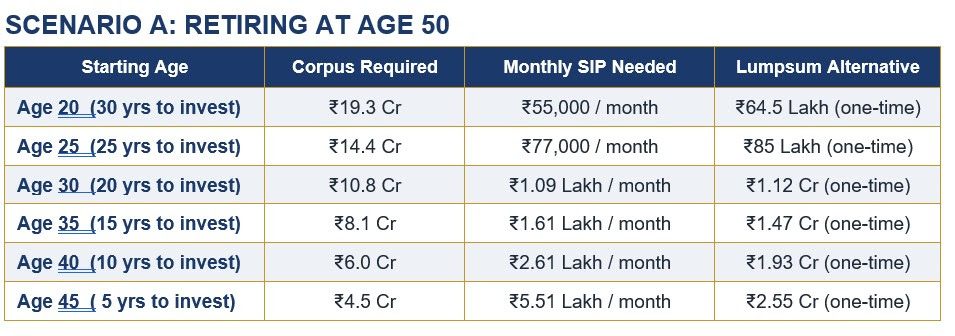
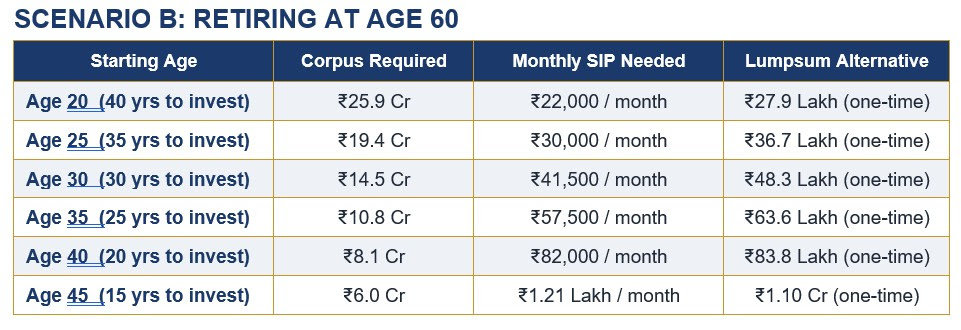
Assumptions: Current monthly lifestyle expense: ₹1 Lakh (today’s value) | Inflation: 6% p.a. | Pre-retirement investment return: 12% p.a. | Post-retirement portfolio return: 7% p.a. | Retirement duration planned to age 85. Healthcare and emergency corpus are additional.

* SIP assumed at 12% p.a. return via diversified  equity mutual funds. Lumpsum amount to be invested today at 12% p.a. SIP  amounts are for ₹1L/month current lifestyle — scale proportionally for your  actual expenses

* Same assumptions as Scenario A. Retiring at 60 benefits significantly from the extra decade of compounding — note how the required SIP is dramatically lower compared to retiring at 50.

The Most Important Insight from These Tables

The difference between starting at age 20 versus age 35 for a retirement at 60 is not a 15-year gap — it is the difference between a ₹22,000 SIP and a ₹57,500 SIP for the same retirement corpus. Compounding rewards patience exponentially. Every year you delay costs you not just one year — it costs you the compounding of that year times 30–40 future years.

How to Scale These Numbers for Your Lifestyle: If your current monthly expense is ₹2 lakhs, multiply all figures by 2. If it is ₹1.5 lakhs, multiply by 1.5. The proportionality is direct.

Hard Facts About Retirement — No Sugarcoating


HARD FACT #1: THERE IS NO LOAN FOR RETIREMENT

Think about every major financial goal in life: You can take a home loan for a house. You can take an education loan for your children. You can take a car loan, a business loan, a gold loan. But there is absolutely no bank, no NBFC, no institution on earth that will give you a ‘retirement loan’. No one will lend you money to fund 30 years of post-retirement life.

This single fact should change everything about how you approach retirement savings. Because every other financial goal has a recovery option — retirement does not. If you miss buying a house, you can rent. If you can’t fund education, there are scholarships and loans. But if you run out of money at age 75, there is no safety net. No bailout. No second chance.

The Blunt Truth

Your children may help. Your savings may stretch. But dignity, independence, and the ability to meet your own healthcare needs — these require a corpus that only YOU can build, starting NOW. The alternative is financial dependence in old age, and that is a deeply uncomfortable position for anyone who has worked hard all their life.

Hard Fact #2: Delaying by 5 Years Doubles Your Required SIP

Look at the tables above. The jump from starting at 30 to starting at 35 (for retirement at 60) takes the required monthly SIP from ₹41,500 to ₹57,500 — a 38% increase for the same outcome. From 35 to 40, it jumps to ₹82,000 — a doubling. Time, once lost, cannot be bought back at any price. A gym membership unused for a year means you restart fitness. An investment SIP missed for five years means you restart compounding — and compounding has no ‘restart’ button.

Hard Fact #3: Your Real Estate Is NOT Your Retirement Plan

Many Indian families hold a significant portion of their wealth in real estate, believing it is their ‘retirement asset’. Real estate is illiquid, expensive to maintain, subject to rental vacancies, and practically impossible to partially redeem. You cannot sell one bedroom of your flat when you need ₹5 lakhs for a medical emergency. Unless you have a structured rental income stream and a clear plan to eventually liquidate, real estate should not be counted as your primary retirement asset.

Hard Fact #4: Fixed Deposits Will Not Save You

A retiree with ₹2 crore in FDs at 7% earns ₹14 lakhs a year or ₹1.17 lakhs a month. After tax (at 30% bracket), this becomes ₹81,900 per month. With 6% inflation, this purchasing power falls to ₹45,800 in 10 years and ₹25,600 in 20 years — in today’s rupees. The FD corpus itself stays nominally the same but loses real value every year. FDs are not a retirement strategy. They are a retirement risk.

Hard Fact #5: Equity Is Not Optional for Retirement

Given inflation at 6% and the need for a retirement portfolio to last 25–35 years, equity exposure is not speculative — it is essential. Even at age 60, a well-managed portfolio should have 30–50% in equity to ensure the corpus does not deplete prematurely. The fear of market volatility must be weighed against the certainty of inflation erosion. We help clients navigate this balance with structured, age-appropriate asset allocation.

What You Should Do Next


Retirement planning is not complicated. But it requires honesty, discipline, and the willingness to start. Here is your action list:

      Write down your current monthly expenses — every rupee

      Decide your target retirement age

      Use the tables in this note as a first-level estimate of your SIP requirement

      Schedule a retirement planning session with your Onesta advisor

      Review and revise your plan every 2 years or after any major life event

      Do NOT pause SIPs during market downturns — they are your retirement’s best friend

“The best time to plant a tree was 20 years ago. The second best time is now.”

— Chinese Proverb | The wisdom of every retirement advisor, ever.

March dip may be an opportunity!

An important market observation that has quietly played out for Indian equity investors over the past several years — something we call The April Theory.

What Is the April Theory?

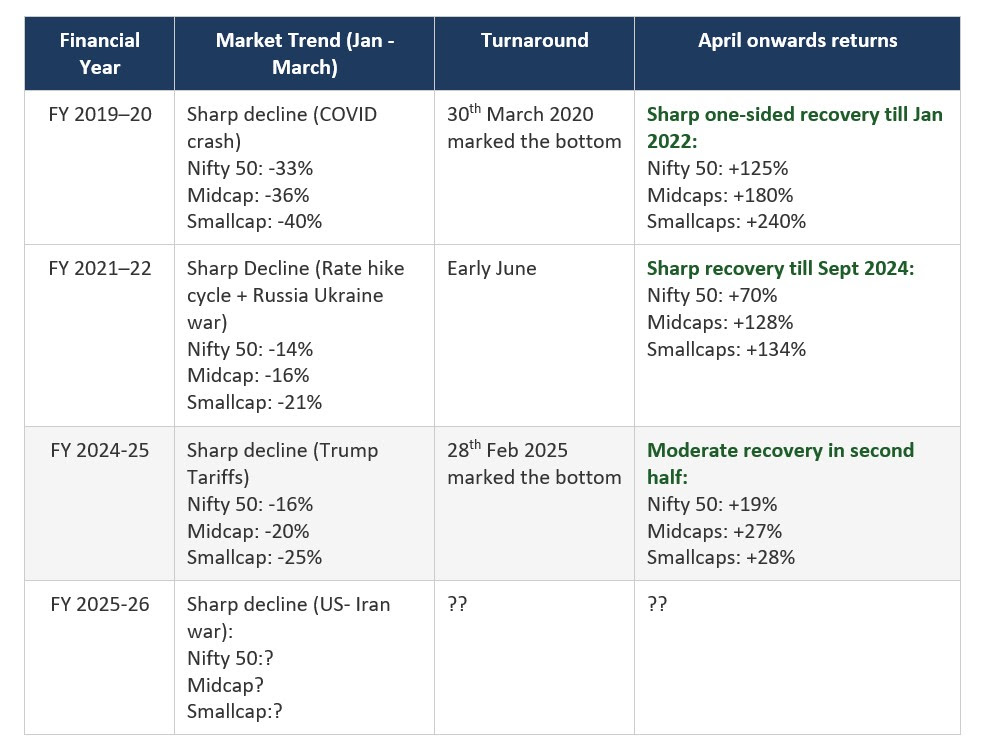
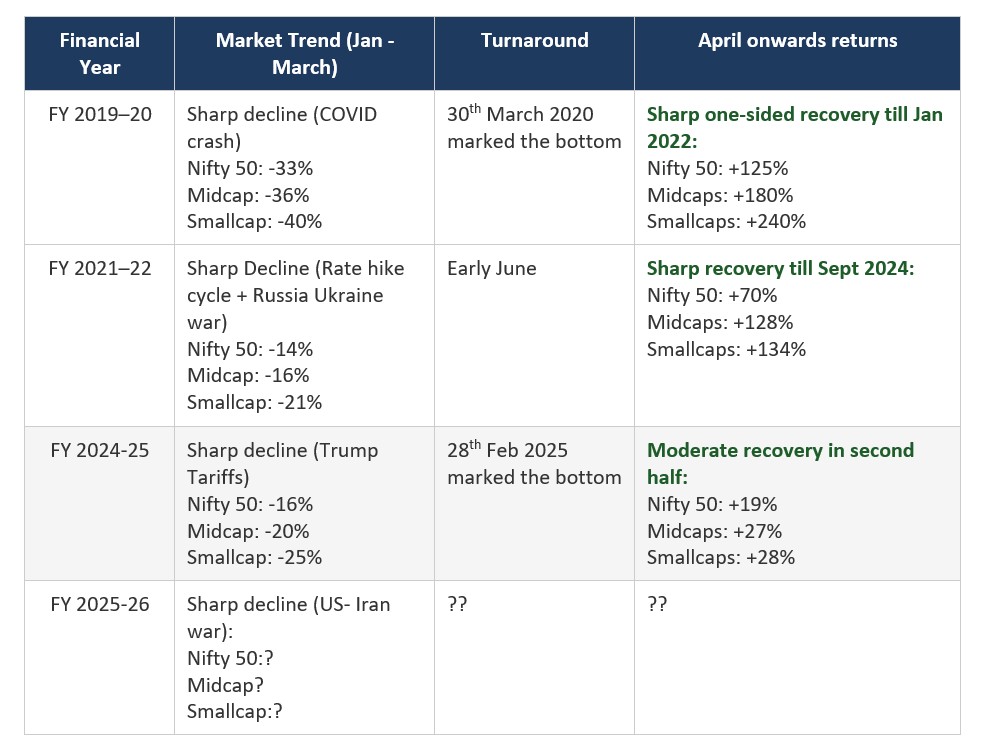
Every year, as India’s financial year draws to a close on March 31st, equity markets tend to witness a phase of selling pressure — often stretching from late February through mid-April. While this can feel unsettling in the moment, history suggests that this weakness is often temporary, and that April frequently marks the turning point for a fresh market upswing.


★  Key   Insight: The April–June quarter has delivered positive returns in 8 out of the last 10 years for the Nifty 50   — making it one of the strongest seasonal windows in Indian equity markets.

The Data Speaks for Itself: Nifty 500 — Last 5 Years

Why Does This Happen? The Tax-Loss Harvesting Effect


The selling pressure into March is not random — it is driven by a well-known but often underappreciated behaviour: Tax-Loss Harvesting.


Indian investors must close their books by March 31st each year. Those who have made gains are liable to pay capital gains tax. To reduce this burden legally, many investors:


1. Identify loss-making holdings in their portfolio

2. Sell them before March 31st to “book” the losses officially

3. Offset these losses against their gains, reducing net taxable capital gains

4. Re-enter the market in April — redeploying capital at the start of the new financial year

Illustrative Example

An investor has ₹7 lakh in capital gains and also holds stocks with ₹3 lakh in unrealised losses.

By selling those loss-making stocks before March 31st, they reduce their taxable gains to just ₹4 lakh — saving significantly at both STCG (20%) and LTCG (12.5%) rates.

After April 1st, these investors return to the market  — fuelling the seasonal recovery.

What Does This Mean for You?

This seasonal pattern does not guarantee future performance, and markets can always surprise. However, the consistent presence of this dynamic suggests:

  • Market weakness in February–March should not be mistaken for a structural breakdown. Much of it is FY-end noise.

  • April often presents an attractive entry point — historically, investors who added to their portfolios during the March–April dip benefitted from the subsequent new-FY rebound.


Being patient through year-end volatility has historically been rewarded. Discipline at this juncture separates  long-term wealth creators from reactive investors.

A Note on Discipline

As always, the right decision depends on your individual financial goals, risk appetite, and investment horizon. We remain committed to guiding you with a clear head and a long-term perspective.

Why the Dollar Remains King

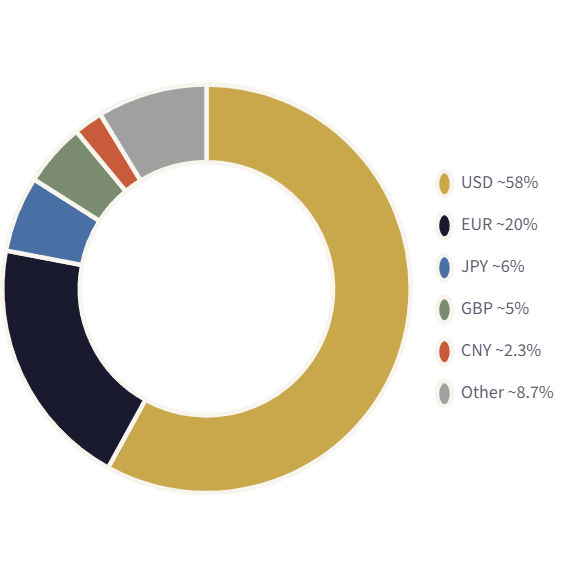
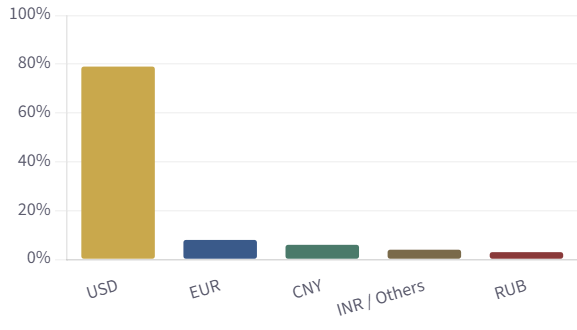
~58% Global FX Reserve Share (USD)

~90% FX Trades Involve USD

~80% Global Oil Trade in USD

In an era of rising multipolarity, deglobalization pressures, and growing calls for de-dollarization, one question dominates macro discussions: can anything dethrone the U.S. dollar? In this edition, we lay out the structural, financial, and geopolitical architecture that keeps the greenback at the apex of the global monetary system — and what risks, if any, could alter this hierarchy.

01 — Reserve Currency Status

The Dollar’s Iron Grip on Global Reserves: The USD has served as the world’s primary reserve currency since the Bretton Woods Agreement of 1944. Central banks globally hold dollars to settle international trade, service dollar-denominated debt, and manage currency volatility. Despite decades of speculation about its decline, the dollar’s reserve share has remained broadly stable.

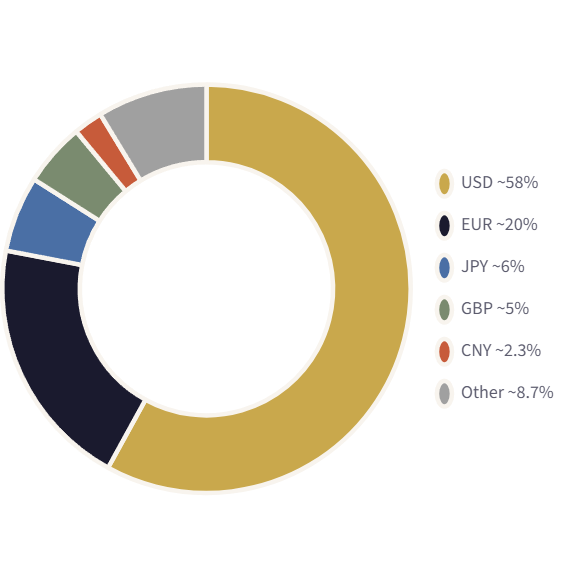
The Euro is a distant second at roughly 20%, followed by the Japanese Yen (~6%) and Pound Sterling (~5%). The Chinese Yuan — despite significant geopolitical push — holds merely ~2.3%, constrained by capital controls and limited financial market depth.

02 — The Petrodollar System

Oil Priced in Dollars: The Indispensable Anchor: The petrodollar system — born from the U.S.–Saudi agreement in 1974 — created a self-reinforcing loop: oil is priced and settled in USD globally, meaning every nation that imports oil must hold dollars. This single mechanism ensures perpetual global demand for the greenback, regardless of U.S. trade deficits.

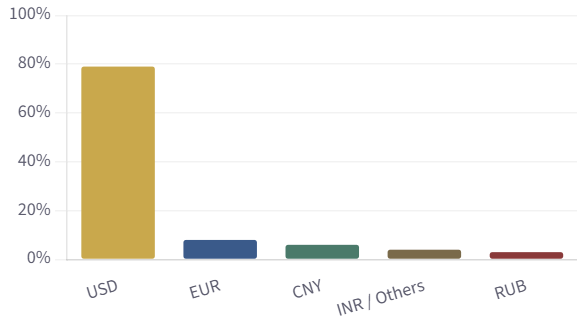
While there are growing experiments with yuan, rupee, and dirham-denominated oil trades (particularly between Russia, China, India, and Gulf states), these represent a small fraction of total flows. OPEC+ nations still invoice the overwhelming majority of crude exports in USD, keeping the structural architecture intact.

“The petrodollar is not merely a trade mechanism — it is a geopolitical instrument. As long as oil remains the world’s primary energy input and is priced in dollars, the United States benefits from an extraordinary structural privilege: the ability to run persistent deficits financed by the rest of the world’s need to hold its currency” — Macro Strategy Desk Analysis

03 — Money Supply & Fed Policy


Dollar Printing: Exorbitant Privilege or Ticking Clock?: The U.S. Federal Reserve has the unique ability to create dollar liquidity that the entire world absorbs. During COVID-19 (2020–2021), the Fed expanded its balance sheet from ~$4T to over $9T — a near-doubling — yet the dollar remained the world’s safe-haven. This reflects the “exorbitant privilege” coined by French economist Valéry Giscard d’Estaing: the U.S. can finance its deficits in its own currency without the currency crisis that would befall any other nation.


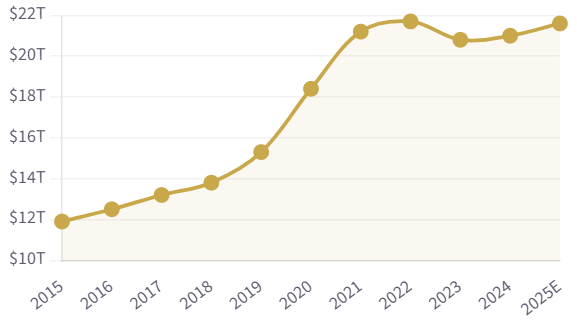
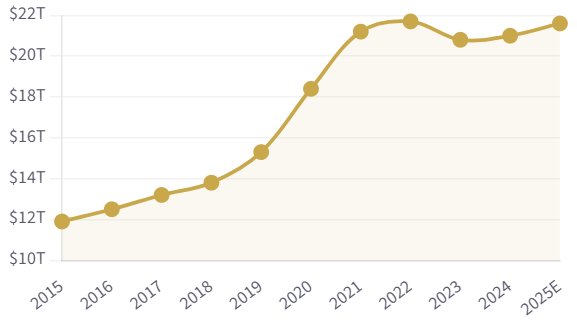
The M2 money supply in the U.S. grew from approximately $15 trillion in 2019 to over $21 trillion by 2022. Despite this aggressive expansion, global dollar demand — driven by trade, debt servicing, and reserve accumulation — absorbed the excess supply, limiting the inflationary global spillover onto dollar dominance itself.

04 — Dollar Trade Dominance


SWIFT, Trade Finance & the Network Effect: Beyond oil and reserves, the dollar dominates because of deeply embedded network effects. Approximately 40% of global trade invoicing occurs in USD — far exceeding the U.S.’s share of world trade (~12%). SWIFT, the global financial messaging system, routes the majority of international transactions through dollar-clearing correspondent banks in New York.


This creates a sticky, self-reinforcing ecosystem: businesses invoice in dollars because counterparties expect it; banks hold dollar liquidity because loans are dollar-denominated; and sovereign borrowers issue dollar bonds because global investors demand them. The transition cost of shifting this network is enormous.

05 — The Road Ahead


USD Outlook: Structural Resilience, Gradual Erosion: The USD share in global reserves has declined from ~71% in 2000 to ~58% today — a shift, not a collapse. The rise of BRICS payment mechanisms, yuan internationalisation, and gold accumulation by emerging market central banks represent diversification, not displacement.


The key risks to monitor are: a significant loss of U.S. institutional credibility (fiscal dysfunction, debt ceiling crises), a viable deep-liquidity alternative emerging (unlikely before 2035), or a commodity market structural shift away from oil (long-term energy transition scenario).


The dollar’s throne is not under immediate threat. Its dominance rests on three interlocking pillars — financial network effects, the petrodollar system, and U.S. capital market depth — none of which can be dismantled overnight.

Invest Like the Japanese in India

While markets often react to short-term narratives, some of the most enduring wealth has been created by investors who think in decades, not quarters. Japanese and Korean capital in India offers a powerful case study of this long-term mindset. Across automobiles, financial services, energy, electronics, and manufacturing, they have invested in 2,000+ Indian companies, consistently backing scale, governance, and execution rather than short-term cycles.

From Suzuki’s journey with Maruti, to Hitachi’s transformation of ABB’s power grid business, to Nippon Life’s revival of Reliance Mutual Fund, these investments reveal a clear pattern:


Long-term capital + operational discipline + local execution = sustained wealth creation.


As global patient capital commits to India’s multi-decade growth story, we believe investors should align with this same long-term conviction.

  1. Maruti Suzuki: 120X in 23 years

    Maruti Suzuki is India’s largest carmaker, selling more cars annually than several global markets combined. With deep localization, the country’s widest sales and service network, and strategic backing from Suzuki Motor Corporation, the company has remained the market leader for over 40 years. It is India’s Largest Exporter of Passenger Vehicles with a Share of Nearly 43%.


    Initially, Maruti was majority-owned by the Indian government, with Suzuki only taking a 26% stake during its establishment in 1982. The Indian government gradually reduced its stake, partially departed the business in 2003 by making it a public company and then sold all of its remaining shares to Suzuki Motor Corporation in 2007.

  1. Hitachi Energy’s Acquisition of ABB: 1500X in 6 years

    Hitachi is a global Japanese conglomerate focused on technology, industrial systems, and infrastructure solutions, including energy, mobility, and digital technologies.

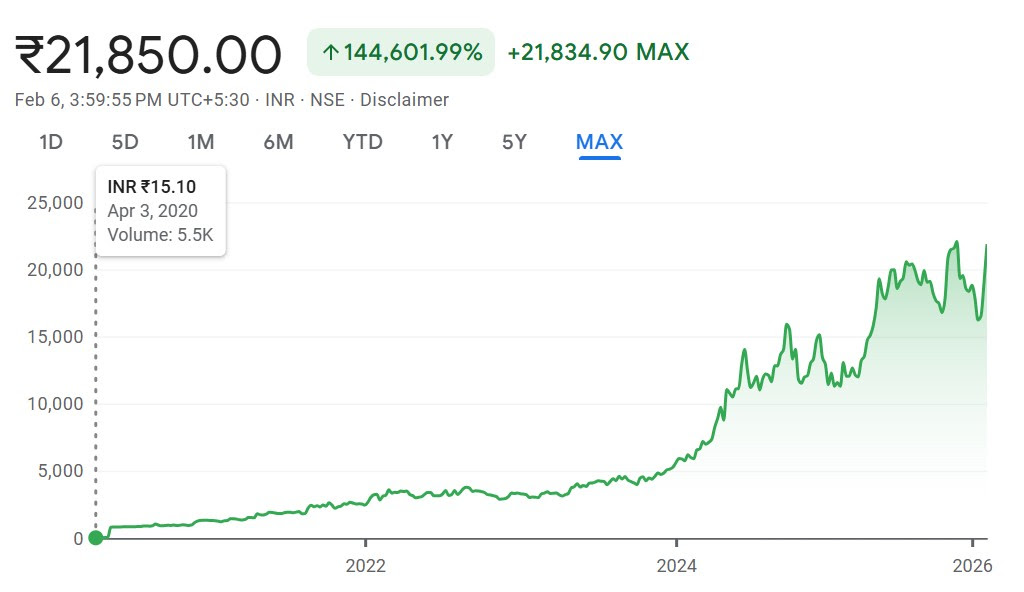
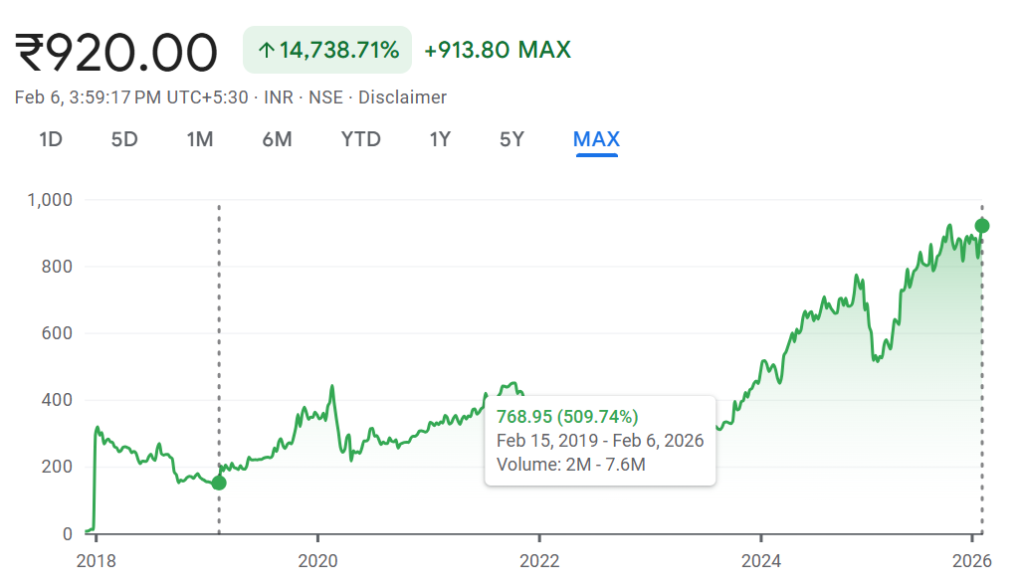
    In July 2020, Hitachi Ltd. acquired an 80.1 % stake in ABB’s Power Grids business, creating a global energy technology leader with about $10 billion in annual revenue and a presence in 90+ countries. The business was renamed  Hitachi Energy as part of the Japanese group’s strategic expansion into power transmission and digital grid solutions.

  1. Lumax Industries


    Lumax Industries is one of India’s leading automotive lighting and components manufacturers, supplying to major OEMs across passenger vehicles, two-wheelers, and commercial vehicles.

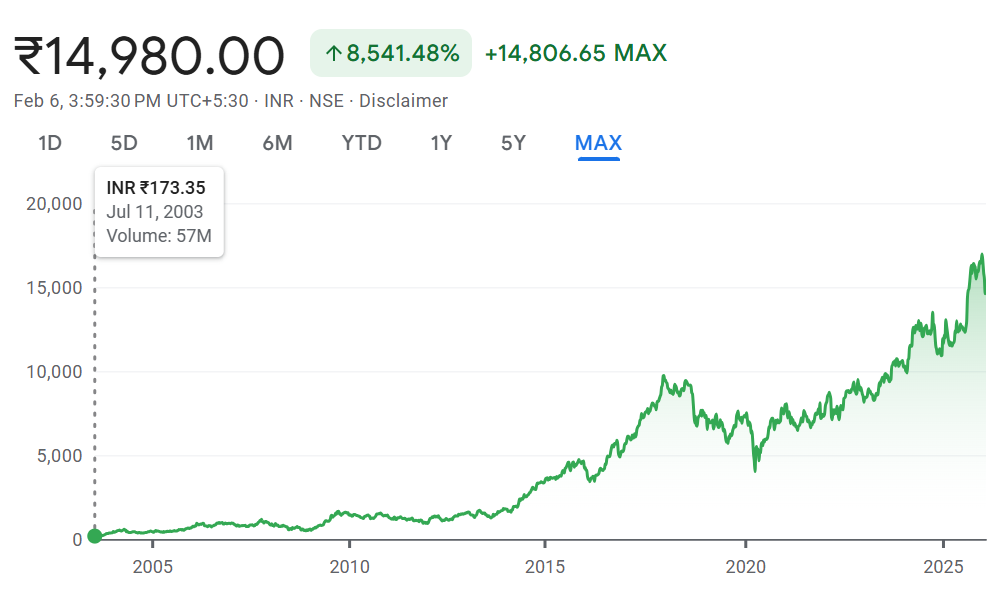
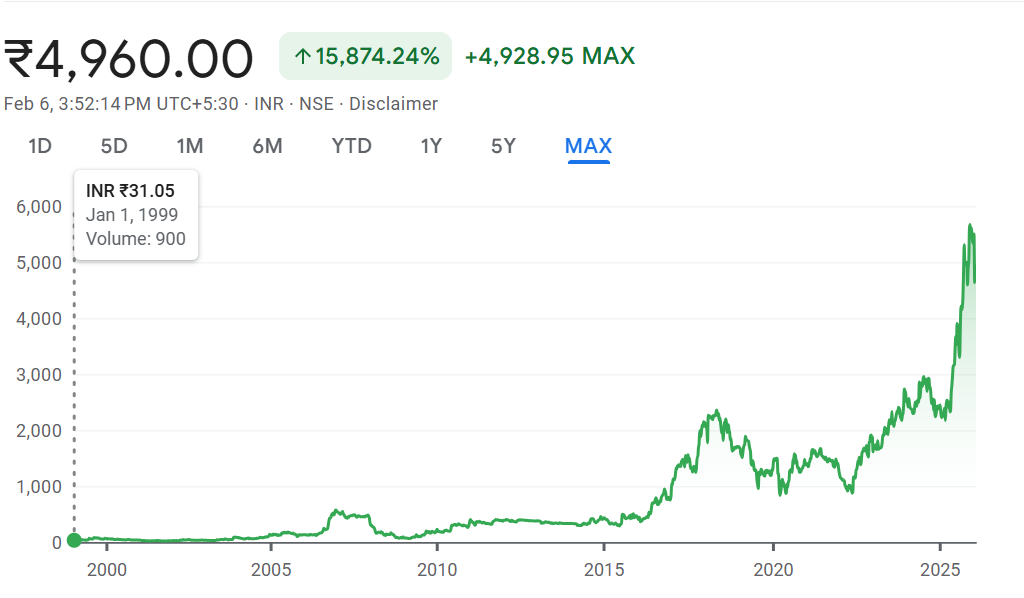
    Lumax Industries has compounded steadily on the back of its long-standing technical partnership with Japan’s Stanley Electric, which holds a strategic stake and provides access to advanced automotive lighting technology. Since its listing, Lumax’s stock has risen from ~₹31 (1999) to ~₹4,700+, translating into over 150× wealth creation, driven by consistent capacity expansion, strong OEM relationships, and disciplined manufacturing aligned with Japanese quality standards.

  1. Nippon’s Reliance MF Journey: 5X in 6 years


    Prior to the 2019 Nippon takeover, Reliance Mutual Fund saw its overall market share fall from about 12% to around 8.5%  over a four‑year period. In 2019, Nippon Life Insurance of Japan acquired a majority stake (75%) in Reliance Mutual Fund, leading to its rebranding as Nippon India Mutual Fund. This marked the transition from being  part of the Reliance group to being majority‑owned by one of Japan’s largest  life insurers, bringing global expertise and stronger risk‑management  frameworks to the business.

Japan/Korean-linked corporates continue to deepen their India play. LG Electronics (listed recently) has significantly expanded manufacturing in India across consumer electronics and home appliances, tapping local demand and exports, while Hyundai Motor Company (recently listed), reflects strong localization and EV strategy. These developments highlight a broader shift toward technology transfer, scale creation, and long-term structural investments — reinforcing the theme of disciplined, patient capital in India.

Japanese/Korean Investments in India in 2025

  1. In 2025, Japan’s SMBC (Sumitomo Mitsui Banking Corporation) — part of the Sumitomo Mitsui Financial Group (SMFG) — agreed to buy a large stake (around 24.22%) in Yes Bank from existing Indian shareholders.

  2. In late 2025, Japan’s MUFG (Mitsubishi UFJ Financial Group) agreed to invest around ₹39,600+ crore to buy a 20% stake in Shriram Finance Ltd — one of India’s largest non-bank financial companies (NBFCs).


I believe Japan/Korea will increasingly view India as its next major growth market, and I am willing to bet on this trend due to the following structural factors:

  1. Japanese corporations are globally respected for their ethical governance, punctual execution, and long-term orientation, making them reliable partners and investors.

  2. Japan is a cash-rich economy facing structural stagnation due to an ageing and declining population. As the world’s fourth-largest economy, it urgently needs high-growth destinations to deploy capital.

  3. Under the Japan–US trade framework, Japan has committed to investing ~$500 billion in the US while sharing profits with US, making diversification imperative to avoid over-dependence on its largest market.

  4. China–Japan relations are at multi-decade lows, with Japan increasingly viewing China as a strategic threat. In contrast, Japan has significantly over-invested in India, deploying ¥247 billion more than its committed amount in FY2025, signalling strong long-term confidence in India as a strategic and economic partner.

As investors, the opportunity is not to predict the next quarter, but to align with businesses and themes that can compound over many years. When some of the world’s most disciplined investors are committing patient capital to India, it reinforces our belief that long-term ownership, not short-term timing, is the most reliable path to wealth creation. We remain focused on staying invested in quality, scale, and governance-led opportunities that can benefit from India’s multi-decade growth journey.

The Silent Takeover of Indian Hospitals

Foreign investors have withdrawn nearly ₹1.65 lakh crore from Indian equity markets in 2025.
Yet, amid this broad sell-off, one sector is attracting foreign capital like never before: Indian hospitals.


Today, nearly half of India’s leading hospital chains are owned or controlled by global private equity.


This shift did not happen overnight.

The Turning Point: 100% FDI in Healthcare


In 2015–16, India quietly opened the floodgates by allowing 100% Foreign Direct Investment (FDI) in healthcare—no caps, no prior government approval, full foreign ownership.


Since then, global capital has moved decisively into Indian healthcare:

  • Manipal Hospitals: 59% owned by Temasek

  • Care Hospitals: 73% owned by Blackstone

  • Medanta (Global Health): backed by CVC Capital

  • KIMS: ~80% owned by Blackstone

  • BMH: ~70% owned by KKR

  • Sahyadri Hospitals: 100% owned by Ontario Teachers’ Pension Plan

Why Global Capital Is So Bullish on Indian Healthcare


The reasons are structural and compelling:

  1. A $650 billion market — simply too large to ignore.

  2. Severe capacity shortage — just 0.6 hospital beds per 1,000 people, versus the recommended 3 beds.

  3. Rising affordability — driven by government schemes, corporate health cover, and individual insurance penetration.

  4. Exceptional wealth creation — hospital stocks have delivered stunning returns in just five years:

    • Fortis: ~400%

    • Max Healthcare: ~559%

    • Narayana Health: ~320%

    • Artemis Hospitals: ~1,085%

    • Apollo Hospitals: ~200%

  5. Demographics — over 19 crore Indians are above 60, sharply increasing demand for chronic and elderly care.

  6. Disease burden — 1 in 4 Indians suffers from some illness; India is already the diabetes capital of the world, and is rapidly moving toward being a major hub for hypertension and cancer cases.

  7. Medical tourism boom — India ranks among the top 5 global medical tourism destinations, attracting ~2 million international patients annually and generating an industry worth ~$13 billion.

  8. Government red carpet — full foreign ownership without prior approval has made India one of the easiest healthcare markets for global investors to enter.

The Other Side of the Story: Serious Concerns


However, this surge of private equity ownership is not without risks.

  • Profit vs. patient care: A recent study led by researchers at Harvard Medical School found that patients are more likely to suffer complications, infections, or adverse outcomes after hospitals are acquired by private equity firms.

  • Changing role of doctors: Doctors are increasingly treated as employees with revenue and margin targets, rather than autonomous professionals focused solely on patient outcomes.

  • Long-term risks: While foreign capital may drive short-term expansion and efficiency, it could come at the cost of quality, affordability, and equitable access over time.


Global capital may be voting with its money—but the real question is whether India’s healthcare system will ultimately serve patients first, or portfolios first.

Why the Dollar Remains King

~58% Global FX Reserve Share (USD)

~90% FX Trades Involve USD

~80% Global Oil Trade in USD

In an era of rising multipolarity, deglobalization pressures, and growing calls for de-dollarization, one question dominates macro discussions: can anything dethrone the U.S. dollar? In this edition, we lay out the structural, financial, and geopolitical architecture that keeps the greenback at the apex of the global monetary system — and what risks, if any, could alter this hierarchy.

01 — Reserve Currency Status


The Dollar’s Iron Grip on Global Reserves: The USD has served as the world’s primary reserve currency since the Bretton Woods Agreement of 1944. Central banks globally hold dollars to settle international trade, service dollar-denominated debt, and manage currency volatility. Despite decades of speculation about its decline, the dollar’s reserve share has remained broadly stable.


The Euro is a distant second at roughly 20%, followed by the Japanese Yen (~6%) and Pound Sterling (~5%). The Chinese Yuan — despite significant geopolitical push — holds merely ~2.3%, constrained by capital controls and limited financial market depth.

02 — The Petrodollar System

Oil Priced in Dollars: The Indispensable Anchor: The petrodollar system — born from the U.S.–Saudi agreement in 1974 — created a self-reinforcing loop: oil is priced and settled in USD globally, meaning every nation that imports oil must hold dollars. This single mechanism ensures perpetual global demand for the greenback, regardless of U.S. trade deficits

While there are growing experiments with yuan, rupee, and dirham-denominated oil trades (particularly between Russia, China, India, and Gulf states), these represent a small fraction of total flows. OPEC+ nations still invoice the overwhelming majority of crude exports in USD, keeping the structural architecture intact

“The petrodollar is not merely a trade mechanism — it is a geopolitical instrument. As long as oil remains the world’s primary energy input and is priced in dollars, the United States benefits from an extraordinary structural privilege: the ability to run persistent deficits financed by the rest of the world’s need to hold its currency” — Macro Strategy Desk Analysis

03 — Money Supply & Fed Policy


Dollar Printing: Exorbitant Privilege or Ticking Clock?: The U.S. Federal Reserve has the unique ability to create dollar liquidity that the entire world absorbs. During COVID-19 (2020–2021), the Fed expanded its balance sheet from ~$4T to over $9T — a near-doubling — yet the dollar remained the world’s safe-haven. This reflects the “exorbitant privilege” coined by French economist Valéry Giscard d’Estaing: the U.S. can finance its deficits in its own currency without the currency crisis that would befall any other nation.


The M2 money supply in the U.S. grew from approximately $15 trillion in 2019 to over $21 trillion by 2022. Despite this aggressive expansion, global dollar demand — driven by trade, debt servicing, and reserve accumulation — absorbed the excess supply, limiting the inflationary global spillover onto dollar dominance itself.

04 — Dollar Trade Dominance


SWIFT, Trade Finance & the Network Effect: Beyond oil and reserves, the dollar dominates because of deeply embedded network effects. Approximately 40% of global trade invoicing occurs in USD — far exceeding the U.S.’s share of world trade (~12%). SWIFT, the global financial messaging system, routes the majority of international transactions through dollar-clearing correspondent banks in New York.


This creates a sticky, self-reinforcing ecosystem: businesses invoice in dollars because counterparties expect it; banks hold dollar liquidity because loans are dollar-denominated; and sovereign borrowers issue dollar bonds because global investors demand them. The transition cost of shifting this network is enormous.

05 — The Road Ahead


USD Outlook: Structural Resilience, Gradual Erosion: The USD share in global reserves has declined from ~71% in 2000 to ~58% today — a shift, not a collapse. The rise of BRICS payment mechanisms, yuan internationalisation, and gold accumulation by emerging market central banks represent diversification, not displacement.


The key risks to monitor are: a significant loss of U.S. institutional credibility (fiscal dysfunction, debt ceiling crises), a viable deep-liquidity alternative emerging (unlikely before 2035), or a commodity market structural shift away from oil (long-term energy transition scenario).


The dollar’s throne is not under immediate threat. Its dominance rests on three interlocking pillars — financial network effects, the petrodollar system, and U.S. capital market depth — none of which can be dismantled overnight.

March dip may be an opportunity

As we approach the final weeks of the financial year, we wanted to share an important market observation that has quietly played out for Indian equity investors over the past several years — something we call The April Theory.

What Is the April Theory?


Every year, as India’s financial year draws to a close on March 31st, equity markets tend to witness a phase of selling pressure — often stretching from late February through mid-April. While this can feel unsettling in the moment, history suggests that this weakness is often temporary, and that April frequently marks the turning point for a fresh market upswing.


★  Key   Insight: The April–June quarter has delivered positive returns in 8 out of the last 10 years for the Nifty 50   — making it one of the strongest seasonal windows in Indian equity markets.


The Data Speaks for Itself: Nifty 500 — Last 5 Years

Why Does This Happen? The Tax-Loss Harvesting Effect


The selling pressure into March is not random — it is driven by a well-known but often underappreciated behaviour: Tax-Loss Harvesting.


Indian investors must close their books by March 31st each year. Those who have made gains are liable to pay capital gains tax. To reduce this burden legally, many investors:


1. Identify loss-making holdings in their portfolio

2. Sell them before March 31st to “book” the losses officially

3. Offset these losses against their gains, reducing net taxable capital gains

4. Re-enter the market in April — redeploying capital at the start of the new financial year


Illustrative Example

An investor has ₹7 lakh in capital gains and also holds stocks with ₹3 lakh in unrealised losses.

By selling those loss-making stocks before March 31st, they reduce their taxable gains to just ₹4 lakh — saving significantly at both STCG (20%) and LTCG (12.5%) rates.

After April 1st, these investors return to the market  — fuelling the seasonal recovery.

What Does This Mean for investors?

This seasonal pattern does not guarantee future performance, and markets can always surprise. However, the consistent presence of this dynamic suggests:

  • Market weakness in February–March should not be mistaken for a structural breakdown. Much of it is FY-end noise.

  • April often presents an attractive entry point — historically, investors who added to their portfolios during the March–April dip benefitted from the subsequent new-FY rebound.


Being patient through year-end volatility has historically been rewarded. Discipline at this juncture separates  long-term wealth creators from reactive investors.