Monthly Market update & Outlook – January’23

Importance of long-term investing:


In the last 42 years, the rupee has lost 97% of its purchasing power due to inflation whereas the Indian stock market index, Sensex has appreciated by astonishing 40,939% (409 times in 42 years). The only way to create wealth is to invest in assets that returns >= the rate of inflation (considering the risk profile and asset allocation).

From the industry leaders:

Indian macro dataflow moderated but remained strong:

  • Manufacturing PMI: Manufacturing PMI moderated to 55.4 from 57.8 in December but remained in expansion zone (>50 points) for the 19th straight month;

  • GST Collection: Collections of Rs. 1.55 Tn in Jan’23 is the second highest GST collection till date;

  • Credit growth: Credit growth moderated to 14.9% YoY due to higher interest rates;

  • Inflation: Dec’22 CPI inflation eased to a 11 month low of 5.88% – below the monetary policy committee (MPC) target. However, core inflation is still above 6%.

  • Trade Deficit: Trade deficit continued to remain elevated at >$25B on continued deceleration in exports and strong domestic demand of imported goods (including higher prices for crude). India’s exports to China fell from $28.1 billion to $17.48 billion in 2022. The trade deficit reached $101.02 billion in 2022, up 45% YoY.

  • ForexIndia’s foreign exchange reserves rose by $3.03 billion to $576.761 billion in the week ending on January 27.

Equities:

  • Broad benchmark indices were down in the month of Jan- Nifty 50 by 2.4%, Smallcap 100 by 2.4% and Midcap 150 by 2.6%;

  • FPIs sold INR 41,464 cr. of Indian equities in the month of Jan’23;

  • Mutual Funds SIP inflows touched record high of INR 13,856 cr. for the month of Jan’23. Net investments in equity through mutual funds surged 70% to INR 12,546 cr.

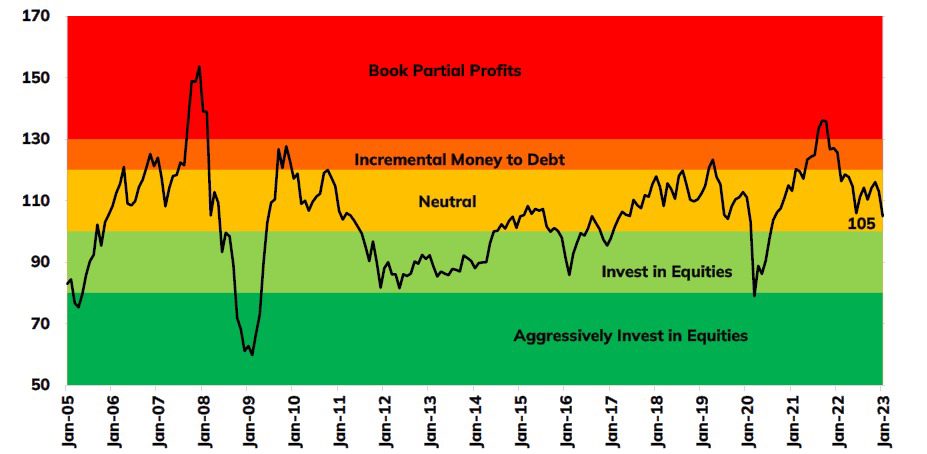
  • The Indian equities have witnessed a time correction in the last one year (Increase in corporate profits leading to fall in valuations without any major fall in prices). A few percentage fall may make equities attractive for lumpsum investments.

Fixed income:

  • RBI MPC hiked rates by 25bps on February 8, 2023;

  • Similar rate hikes were done by US Feb (0.25%), Bank of England (0.5%) and European central Bank (0.5%);

  • 10 year G-Sec yield is hovering around 7.3%.

Outlook:

  • From domestic growth perspective, we believe that the RBI is closer to the peak of rate hike cycle. But the rate reversal cycle might not be immediate as it is linked to how other central banks evolve their stance;

  • While corporate earnings remaining reasonably on track for FY23, the outlook on FY24 remains a function of global growth as well as interest rates;

  • The challenge lies in the fact that some of the emerging markets, including China are trading a reasonable discount to their own long-term trends and this perhaps makes India less attractive at present to global investors, who are focussed on near-term valuations;

  • For Indian economy, the big picture clearly is the journey to getting to the third-largest economy status which could see economy nearly doubling in size and this growth is likely to permeate across sectors and market caps (large, mid, small) as companies strive for profitable growth and create wealth for investors. We believe increasing exposure to equities in a disciplined manner with the objective of staying invested for longer-term could support wealth creation for investors.

Disclaimer: The views expressed herein constitute only the opinions/ facts and do not constitute any guidelines or recommendation on any course of action to be followed by the reader. This information is meant for general reading purposes only and is not meant to serve as a professional guide for the readers.

Economic survey & Union budget update – 2023

The Union Budget is one of the most awaited financial events in the country. Union Minister of Finance, Smt. Nirmala Sitharaman presented the first budget of Amrit Kaal before the parliament today. Key highlights of the same are mentioned below for your easy perusal:

Economic Survey: it is prepared by the Department of Economic Affairs (DEA) under the guidance of Chief Economic Advisor V Anantha Nageswaran.

  • GDP: India to remain the fastest-growing major economy in the world. India’s GDP growth is expected to remain robust at 7% in FY23 and thereafter 6.5% in FY24 (in real terms);

  • Domestic demand is solid. The government increased capital expenditure significantly;

  • India is the third largest economy in (purchasing power parity) terms, fifth largest in terms of exchange rate;

  • Borrowing costs may remain high for the near future;

  • Current Account Deficit may continue to widen as global commodity prices remain elevated;

  • Rupee may depreciate further if the FED hikes rates aggresively;

  • Electronics exports rise nearly threefold, from US $4.4 billion in FY19 to US $11.6 Billion in FY22;

  • The Gross Tax Revenue registered a YoY growth of 15.5 percent from April to November 2022, driven by robust growth in the direct taxes and GST;

  • Labor markets have recovered beyond pre-Covid levels, in both urban and rural areas, with unemployment rates falling from 5.8 percent in 2018-19 to 4.2 percent in 2020-21;

  • Credit to Micro, Small, and Medium Enterprises (MSMEs) has grown by an average of around 30% since January 2022 and credit to large industries has been showing double-digit growth since October 2022;

  • UPI-based transactions grew in value (121 percent) and volume (115 percent) terms, between 2019-22, paving the way for its international adoption;

  • India’s exports contracted by 12.2% to $34.48 billion in December 2022 due to the global demand slowdown. India’s export growth is likely to be flat in the next fiscal if the global economy does not pick up.

Tax and investment related provisions of the budget:

  • Individuals with an income of upto 7 lacs will not have to pay any tax under the new regime;

  • The tax slabs in the new regime have been reduced to five (from six);

  • The standard deduction for a salaried person having an income of 15.5 lac or more increased to 52,500 under the new regime;

  • The highest surcharge rate has been reduced from 37% to 25% under the new regime;

  • New Regime has been made the default tax regime but there is an option to pay taxes under the old regime as well;

  • Increase in tax exemption limit of leave encashment for non-government employees increased from 3 lacs to 25 lacs;

  • Presumptive taxation limit enhanced from 2 cr. & 50L to 3 cr. and 75L for businesses and professionals where tax receipts are not more than 5% of the total receipts;

  • The cooperative manufacturing unit will get the benefit of 15% tax rate if they commence manufacturing activities before 31.03.2024;

  • A limit of 10 cr. on deduction from capital gains on investment in residential property under sections 54 & 54F is introduced.

  • W.e.f. 1st April 2023, new insurance policies (excluding ULIPs as these are already taxable if the premium is above 2.5 lacs) with premiums above 5 lacs will be taxable;

  • A one-time new small savings scheme, Mahila Samman Savings Scheme will be available for a two-year period up to March 2025. Maximum investment of 2 lac in name of women or girls at a fixed rate of 7.5% can be made;

  • The senior citizen savings scheme limit has been increased from 15 lacs to 30 lacs;

  • The maximum limit for Monthly Income Account Scheme will be enhanced from 4.5 lacs to 9 lacs for single and from 9 lacs to 15 lacs for joint holders;

  • Relief in customs duty on import of certain mobile parts like camera lens and concessional duty on Lithium ion cells for batteries extended for another year;

Other key relevant highlights of the budget:

  • PM Garib Kalyan Anna Yojana is launched w.e.f. 1/1/2023 to supply free food grains to all antyodaya and priority households;

  • The agricultural credit target has been increased to 20L cr.

  • The outlay for PM Awas Yojana is being enhanced by 66% to over 79,000 cr.

  • A 10L cr. capex target for 2023-24 which is 33% higher than the budget estimate of 7.5L cr.

  • A capital outlay of 2.4L crore has been provided for the railways;

  • Three centers of excellence for Artificial Intelligence will be set up in top educational institutions;

  • 48% rise in allocation towards renewable energy sector;

  • PM Kaushal Vikas Yojana 4.0 will be launched to skill lakhs of youth within the next three years;

  • MSMEs will be provided a credit guarantee of 2L crore and a reduction in the cost of borrowing by 1%;

  • To enhance investors’ protection, the Banking Regulation Act, the Banking Companies Act and RBI Act are proposed;

  • Fully imported cars, including EVs to cost more;

  • Ministry of electronics and IT has received 16K cr. of allocation – double than what it was two years back;

  • An integrated IT portal will be set up to reclaim unclaimed shares and unclaimed dividends from the investor education and protection fund;

Our take on the budget:


The focus of the budget was primarily on seven sectors, including domestic manufacturing, infrastructure development, and green power. From agriculture to the digital economy, the Government is trying to lay a strong foundation in all the sectors for India’s multi-year growth. We are confident of India’s growth story and it becoming a $ 5 trillion economy by 2030 and $ 25 trillion by 2047.


However, India is one of the countries where the savings ratio is very low. Instead of promoting the habit of savings, the Government is trying to shift to the new regime wherein there are no major deductions available and at the same time, taxing underpenetrated investment products like equities, mutual funds, insurance etc.


One of the most neglected sectors, tourism, found its mention in the budget today. Setting up of 50 new airports and heliports is a welcome move. Overall the budget was growth-oriented, inclusive, and prudent.

Monthly market update & outlook – December’22

“Unless you buy a stock at the exact bottom (which is next to impossible), you will be down at some point after you make every investment. Your success entirely depends on how dispassionate you are towards short term stock price fluctuations.” -Joel Greenblatt

In the last one year we have observed that many new investors suffer from financial anxiety because they indulge in the futility of trying to predict the market. Timing the market & consistently doing it is near impossible task (unless there is a black swan event like COVID, War, etc. where there is an intense selling by a few big players). This financial anxiety results in Invetment return > Investor’s return.

Indian macro dataflow remained strong:

  • Manufacturing PMI: Manufacturing PMI rises to highest in over two years, reaching 57.8, and remained in expansion zone (>50 points) for the 18th straight month;

  • GST Collection: Collections of INR 1.49 Tn (+15% YoY) in Dec’22 concluded the tenth consecutive month of collections over 1.4Tn mark. Increased revenue from imports and domestic transactions have led to the sustained levels;

  • Credit growth: Credit growth accelerated to 17.4% YoY as of 16th Dec 2022 against YoY growth of 6.21% as observed on 16th Dec 2021;

  • Inflation: Dec’22 CPI inflation eased to a 11 month low of 5.88% – below the monetary policy committee (MPC) target;

  • Trade Deficit: Trade deficit continued to remain elevated at >$25B on continued deceleration in exports and strong domestic demand of imported goods;

  • Forex: India’s forex reserves increased to $563B – enough to sustain nine months of imports;

 
Equities:
 
  • Indian equities snapped a two month gain in Dec-22, with Sensex & Nifty declining 4% each;

  • FPIs bought $1B of Indian equities in the month of December

 
Fixed income:
 
  • RBI MPC hiked rates by 35bps;

  • RBI hiked interest rates on small savings schemes (Term deposits, NSC, Senior Citizen Savings Scheme) by 110bps.


Outlook:


As we enter 2023, we see an environment where both inflation and growth might be slowing. Both from cyclical and structural perspective, India seems to be better placed vs rest of the World. Domestic demand continues to be strong. Policy reforms, huge under investments in Capex, stronger corporate Balance Sheets have potentially created a robust platform for a virtuous cycle of growth.


While India is likely to be amongst the fastest growing economies, the near-term global uncertainties are unlikely to wither away soon and the volatility can be potentially higher in the short run.


Disclaimer: The views expressed herein constitute only the opinions/ facts and do not constitute any guidelines or recommendation on any course of action to be followed by the reader. This information is meant for general reading purposes only and is not meant to serve as a professional guide for the readers.

Sensex @500,000 – A dream or reality?

“When Sensex was around 6,000, I was asked by CA Anil Singhvi (Managing Editor- Zee Business) whether it will ever cross 30,000 (5X from that level). Today it stands at 60,000 & it is just a beginning of a long-term movie”

– CA Madhusudan Kela (Ex-Chief Investment Strategist- Reliance Capital) at ICAI World Congress of Accountants 2022

(more…)

Your equity portfolio may oscillate by 20% in 2023!

Yes, you read the subject right but…..

With all the ongoing volatility in the stock market, I thought it would be a good time to point out that this is only natural. After two great years of one-sided movement in the stock market (2020-21), investors experienced volatility for the first time during Russia Ukraine war when the Nifty slumped 18% in Mar’22. Continue reading “Your equity portfolio may oscillate by 20% in 2023!”

Do you pay yourself first?

The history of the concept “Pay Yourself First” dates back to almost 100 years back when it was penned down by George Clason in his book called “The Richest Man in Babylon”. It was later reiterated by Robert Kiyosaki in his book, “Rich Dad Poor Dad”. The simple phrase “Pay Yourself First” has made it’s way big in the world of finance, this philosophy is accepted universally and is recognized as the golden rule of personal finance.

Continue reading “Do you pay yourself first?”

The risk of not taking enough risks

‘Risk comes from not knowing what you’re doing’ – Warren Buffet

As human beings, avoiding uncertainties comes naturally to us. We are governed by the need for certain outcomes in almost all aspects of our life & investing is no different. As far as possible, many investors try & avoid taking risks while choosing their investments thereby, completely avoiding equities in their portfolio! But they don’t understand that not taking a certain level of risk is a risk in itself. Continue reading “The risk of not taking enough risks”

Investing for multibagger returns– Direct stocks or mutual funds? Here’s the verdict.

Author’s note:

A lot of our investors lost their hard-earned money by directly investing in stocks like Zomato, Paytm, Policybazar, etc. Even though the benchmarks have recovered but many of the individual stocks are still trading at a deep discount viz-a-viz their all-time highs. We thought of writing an article for such investors who are always in search of the next ‘multibagger’

(more…)