
Foreign investors have withdrawn nearly ₹1.65 lakh crore from Indian equity markets in 2025.
Yet, amid this broad sell-off, one sector is attracting foreign capital like never before: Indian hospitals.
Today, nearly half of India’s leading hospital chains are owned or controlled by global private equity.
This shift did not happen overnight.
The Turning Point: 100% FDI in Healthcare
In 2015–16, India quietly opened the floodgates by allowing 100% Foreign Direct Investment (FDI) in healthcare—no caps, no prior government approval, full foreign ownership.
Since then, global capital has moved decisively into Indian healthcare:
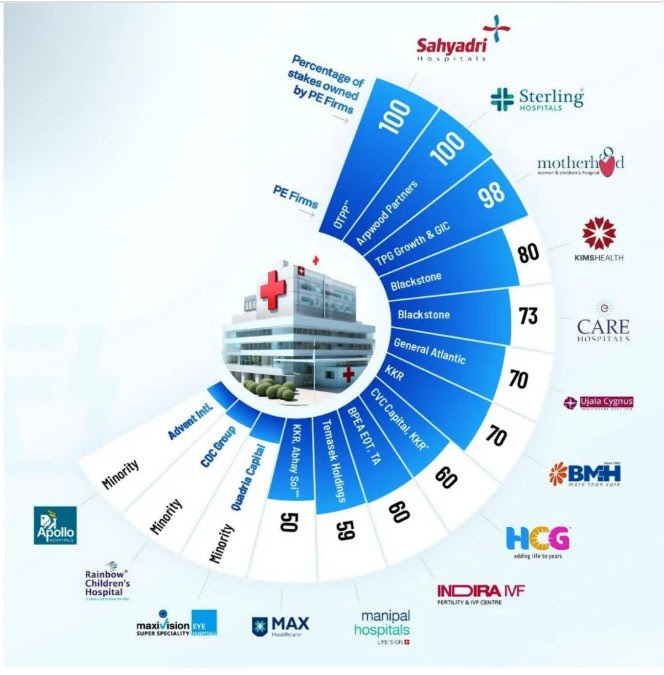
Manipal Hospitals: 59% owned by Temasek
Care Hospitals: 73% owned by Blackstone
Medanta (Global Health): backed by CVC Capital
KIMS: ~80% owned by Blackstone
BMH: ~70% owned by KKR
Sahyadri Hospitals: 100% owned by Ontario Teachers’ Pension Plan
Why Global Capital Is So Bullish on Indian Healthcare
The reasons are structural and compelling:
A $650 billion market — simply too large to ignore.
Severe capacity shortage — just 0.6 hospital beds per 1,000 people, versus the recommended 3 beds.
Rising affordability — driven by government schemes, corporate health cover, and individual insurance penetration.
Exceptional wealth creation — hospital stocks have delivered stunning returns in just five years:
Fortis: ~400%
Max Healthcare: ~559%
Narayana Health: ~320%
Artemis Hospitals: ~1,085%
Apollo Hospitals: ~200%
Demographics — over 19 crore Indians are above 60, sharply increasing demand for chronic and elderly care.
Disease burden — 1 in 4 Indians suffers from some illness; India is already the diabetes capital of the world, and is rapidly moving toward being a major hub for hypertension and cancer cases.
Medical tourism boom — India ranks among the top 5 global medical tourism destinations, attracting ~2 million international patients annually and generating an industry worth ~$13 billion.
Government red carpet — full foreign ownership without prior approval has made India one of the easiest healthcare markets for global investors to enter.
The Other Side of the Story: Serious Concerns
However, this surge of private equity ownership is not without risks.
Profit vs. patient care: A recent study led by researchers at Harvard Medical School found that patients are more likely to suffer complications, infections, or adverse outcomes after hospitals are acquired by private equity firms.
Changing role of doctors: Doctors are increasingly treated as employees with revenue and margin targets, rather than autonomous professionals focused solely on patient outcomes.
Long-term risks: While foreign capital may drive short-term expansion and efficiency, it could come at the cost of quality, affordability, and equitable access over time.
Global capital may be voting with its money—but the real question is whether India’s healthcare system will ultimately serve patients first, or portfolios first.
