
Equity or Debt? Whether to run after capital appreciation through equity or look for secured returns in Debt? The most common dilemma every investor (amateur or pro) goes through in their investment journey!
While some people are naturally risk takers and get their kick from equity investments only but the majority of them are risk averse and always choose Stability over volatility (or I can say FDs over stock markets).
But only a few people know about the category that has benefits of different asset classes – Growth potential of Equity & Security cushion of Debt – Hybrid Funds
A. What are Hybrid Funds (popularly known as Balanced funds also)?
These schemes invest in more than one asset class i.e., equity, debt, Gold & international assets, to diversify the portfolio to earn maximum return with limited risk
Equity portion provides capital appreciation, whereas debt helps to bring stability in terms of risk & return, helping investors to diversify into different asset classes without involving vast amounts of money.
B. Who should invest in Hybrid Funds?
– Risk-averse Investors investing for the first time and are not comfortable with high volatility
– Retired people looking for regular income streams and can’t afford unstable returns
– Investors with low-risk appetite looking for investment opportunities giving better than FD returns
– Investors looking for opportunities across different asset classes without getting into hassle of research and analysis
C. Different categories of Hybrid funds:
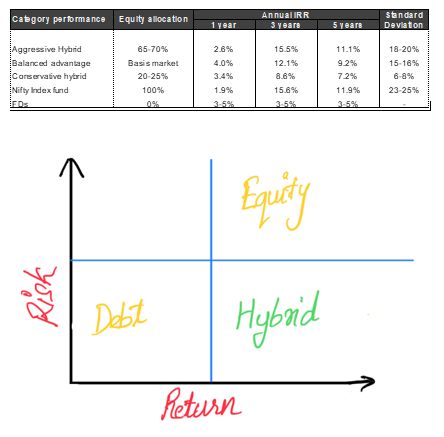
– Aggressive Hybrid funds: Allocates 65- 80% in Equity and the remaining in debt-related instruments
– Conservative hybrid funds: Allocates 75% – 90% in fixed-income securities and rest in equity
– Balanced hybrid funds: Allocates 40-60% in both equities & Debt
– Dynamic asset allocation (or Balance advantage funds): Allocates purely based on market conditions (0-100% in equity).
– Multi-asset Allocation – Invests at least 10% each in 3 asset classes
D. Taxation
Since hybrid funds invest in both equity & debt, the tax treatment depends on the allocation of funds. Funds with more than 65% equity allocation are treated as equity funds and taxable as below:
– If held for more than 12 months – Long term- Exempt up to 1 lakh of gains; 10% taxable after that
– If held for less than 12 months – Short term- Taxable @15%
All the other funds are considered debt funds and are taxable as below:
– If held for more than 36 months – Long term – Taxable @ 20% with the benefit of indexation
– If held for less than 36 months – Short term – Taxed as per slab rate
E. Historical performance of Hybrid funds (Vs. Market) (Refer to table below)
The article was written by Sidhant Gupta (Chartered Accountant – All India Rank 17).
