The Sleeping Town of Coca-Cola Millionaires
Dear Investor,
In the quiet town of Quincy, Florida, an extraordinary wealth story unfolded—one that remains a timeless example of the power of long-term investing.
During the Great Depression when Dow Jones corrected 89%, a local banker urged residents to invest in a company few could ignore: Coca-Cola. At the time, a single share traded for just $19. Many small-town families took his advice and simply held on.
Those who did, and reinvested their dividends, saw staggering results.
A single share of Coca-Cola in the 1930s would be worth over $19 million (Rs. 170 crore) today, purely through compounding and patience.
By the late 1940s, Quincy became the richest town per capita in the entire United States.
Quincy eventually came to be known as “The Town of Coca-Cola Millionaires”—not because its people traded often, but because they believed in quality, stayed the course, and let time do the work.
Even Warren Buffett recognized the value of Coca-Cola early on—he famously began his entrepreneurial journey by selling Coke bottles door-to-door as a child. So when the opportunity arose in the late 1980s, he invested $1.3 billion into the company through Berkshire Hathaway. That investment is now worth over $24 billion. But the most remarkable part? The annual dividend income from Coca-Cola shares alone is around $750 million—nearly 50% of his original investment—showcasing the power of long-term investing and compounding.
At Onesta, this philosophy lies at the heart of our investment approach. We focus on staying aligned with long-term goals—especially during short-term noise.
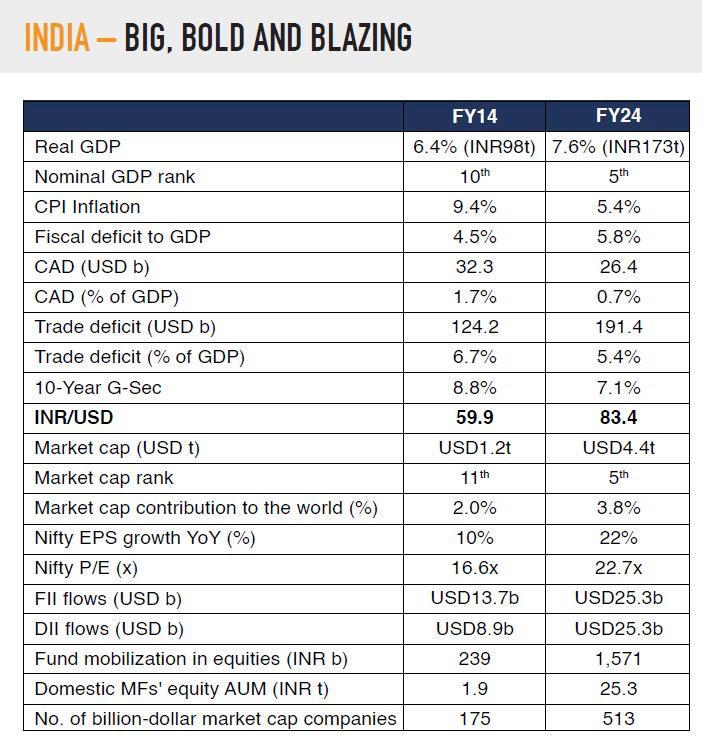
India in Focus: A Growth Story Unfolding
India outpaces global peers, only market to post gains since US tariff-induced lows
“There are more foreign capital focused on India today”: KKR’s co-CEO Joseph Bae
India is the only emerging market that people should own for long term: Mark Matthews
“Markets are fundamentally volatile. No way around it. Your problem is not in the math. There is no math to get you out of having to experience uncertainity.”
-Ed Seykota
Domestic Macroeconomic Snapshot
India’s GDP grew 6.2% YoY in Q3FY25 (Oct–Dec), led by strong government and household spending.
GST Collections hit ₹1.96 lakh crore in March, a 10% YoY rise, marking the 13th straight month above ₹1.7 lakh crore.
CPI Inflation cooled to 3.61% in Feb (from 4.3% in Jan), the lowest in 7 months, driven by food prices.
WPI Inflation rose marginally to 2.38%, indicating higher manufacturing costs.
Core Sector Growth slowed to 2.9% YoY in Feb, a 5-month low due to weak crude and gas output. However, cement (+10.5%) and fertilisers (+10.2%) showed strong momentum.
Industrial Output (IIP) rose 5% in Jan, led by manufacturing (+5.5%) and mining (+4.4%).
Equity Markets: Recovery Mode
After sharp corrections in February, March saw a rebound across segments:
Sensex +5.11%, Nifty 50 +5.34%
Midcap Index +5.62%, Smallcap Index +8.04%
Sector Leaders:
Oil & Gas +11.3%, Metals +10.1%, Healthcare +8.4%
Worst Performers:
Power (-4.3%), PSU (-4.1%), Capital Goods (-3.5%)
Valuations:
Nifty 50 trades at 19.5x, below 5-year average of 24x—suggesting value in large caps.
Small & midcaps still trade at premium, despite recent corrections (Smallcap -13.4%, Midcap -10.2% in Feb).
Fixed Income & Currency
RBI Repo Rate: Cut to 6.25%, balancing inflation & growth.
G-Sec Yields: Despite the cut, 10-yr yield rose to 6.55%, amid liquidity tightness and global cues.
INR/USD: Rupee remained volatile but supported by strong forex reserves of $640 bn.
Institutional Flows (March 2025)
FII Activity: Turned net buyers again post Feb correction.
DII Activity: Continued consistent inflows.
Sentiment improved amid tax cuts, rate cut expectations, and domestic resilience.
Global Highlights
US Services PMI dropped to 49.7 – first contraction in 2 years.
US Inflation at 3% in Jan, up from 2.9% – “last mile” proving sticky.
US GDP slowed to 2.3% in Q4, down from 3.1% in Q3.
Unemployment at 4%, signaling softening labor market.
China cut interest rates, launched fiscal support in response to weak demand and trade tensions.
Brent Crude range-bound around $74.7/barrel – helping tame India’s inflation
The world is watching closely to see if the chaos can be calmed – or if this truly marks a turning point toward a more fractured global economy.
Key Trends for Q2 FY25 (April–June)
Rate Cuts: RBI may ease further by 25–50 bps in CY25, supporting credit and investment.
Consumption revival: Tax cuts and rural demand to boost discretionary and staples.
Capex-Led Growth: Public infra and private capex gaining pace.
Tariff Impact: Global trade frictions and retaliations remain key overhangs.
Valuations: Pockets of value in large caps and defensives; caution in small/midcaps.
Investment Strategy
What may work:
Large Cap, Flexi Cap, and Large & Midcap Funds: Attractively valued, offer scalability
Balanced Advantage, Multi Asset Funds: Hedge volatility with equity-debt allocation
Healthcare & Consumption Thematics: Offer resilience amid uncertain global cues
Approach:
Gradual Re-entry into mid/smallcaps via SIP/STP routes.
Systematic Allocation Reviews in light of personal goals, not just market movement.
What Looks Attractive
Risk-Controlled Approach