Castles are not built in the air

Last week, the Nifty 50 Index touched a significant milestone, crossing 25,000 points. This is noteworthy not just for the number itself but for the pace at which it was achieved—just 221 trading sessions, or roughly eleven months. While this milestone is cause for celebration for many investors, whose portfolios are also reaching all-time highs, we believe it’s a prudent time to reassess the risks in equities.

Valuation Concerns:

  1. Price to Earnings Ratio: The trailing P/E ratio of the BSE500 currently stands at 31x, a level comparable to the pre-COVID era and about 10% higher than the 2007 peak. While these elevated valuations have persisted for some time, the current macroeconomic and earnings backdrop differs significantly from previous periods. In 2017 and post-COVID, low interest rates were a crucial support for these valuations. Today, however, the primary driver is earnings.

  1. Price to Book Ratio: On a P/B basis, the BSE500 is trading at 4.5x, which is 20% higher than pre-COVID levels but below the 2007 Global Financial Crisis peak of 6.5x. The difference lies in the Return on Equity (RoE) profile—while the BSE500 RoE was 25% at the 2007 peak, it was just 10% in 2018 and is around 15% today.

  1. Market Cap to GDP Ratio: The market cap to GDP ratio has once again reached the previous peak of 150% from 2007. This metric effectively captures both primary and secondary market sentiments. However, the economic backdrop has changed—while nominal GDP was growing in the mid-to-high teens in 2007, it is now struggling to reach double digits. This disparity suggests that current market valuations may be out of sync with the real economy.

Why Do Valuations Matter?


When it comes to investing, the initial valuation at which you enter a position is crucial in determining your medium-term returns. While the impact of valuations on short-term performance can be less predictable, their influence over the medium term is undeniable and often decisive.


In light of these rich valuations across multiple metrics, we advise exercising caution in the current market environment. While there may still be opportunities, the potential risks should not be overlooked.

Other indicators which may prove that the market is in overvalued zone:


1.       Record number of IPOs

2.       NFOs raising record money in sectoral funds

3.       Promotor selling in secondary market

4.       Increase in speculative ideas

However, these parameters overlook the concerns surrounding valuations:

  1. Liquidity: With record monthly inflows from SIPs, EPF, NPS, and insurance funds, the market is currently flush with liquidity. The fundamental driver of these flows is income growth, which, if sustained, will likely have positive spillovers across various asset classes.


  2. Strong Balance Sheets: Historically, Indian and emerging market earnings have moved in tandem. However, since the post-COVID recovery, India Inc.’s earnings have significantly outperformed those of other emerging markets. Additionally, from a corporate balance sheet perspective, Indian companies are now much more deleveraged.


  3. CAPEX Cycle Sustainability: The government has been focused on building infrastructure and has invested record amounts over the medium term. For continued economic growth, it’s essential that this CAPEX cycle remains robust.

Predicting the exact inflection points in a market with strong momentum is very challenging. However, we believe that at this stage, the margin of safety is limited.

What Should You Do as an Investor?


The fundamental drivers of India’s multi-decade consumption and infrastructure growth, are still firmly in place. While predicting market direction is impossible, careful planning is essential. If your financial goal is approaching in 2024, it might be wise to consider moving funds out of equities and into safer investment options.


For fresh lump-sum investments, a flexible approach that allows you to diversify across sectors/asset classes could be prudent—consider options like Multi-Asset or Flexicap funds.

For other existing investors, we recommend to stay invested as India’s long-term growth story remains intact.


For SIPs, it’s advisable to continue them, keeping in mind your financial goals and risk tolerance.


We remain vigilant and committed to providing insights that help you navigate these complex market conditions. Please do not hesitate to reach out if you have any questions or would like to discuss this further.

Budget Highlights: What It Means for You

India’s Economic Landscape:


  1. Fastest Growing Economy: India continues to lead as the world’s fastest-growing major economy with a 7.8% GDP growth in Q4FY24,surpassing many of its global peers.

  2. Resilient Economy: Despite global supply chain disruptions, India’s core inflation is declining, showcasing its strong economic resilience.

  3. Robust Foreign Exchange Reserves: A moderated current account deficit and substantial forex reserves provide India with a comfortable import cover for up to 11 months.

  4. Revenue Growth: Increased tax revenues, higher-than-expected non-tax revenues (including RBI dividends), and growing GST collections enable continued government investment in capital expenditure.

  5. Fiscal Discipline: In contrast to global trends, India remains committed to fiscal consolidation, maintaining a stable fiscal stance.

  6. Healthy Corporate Sector: Impaired loans have further decreased, and corporate balance sheets are robust, fostering a favorable environment for private capital expenditure.

  7. Structural Reforms: Government reforms are propelling the economy forward, with expected further boosts from strong execution.

  8. Capital Expenditure: Consistent growth in government capex is setting a solid foundation for economic recovery post-geopolitical shocks.

Budget Priorities:


The budget outlines nine key areas for development aligned with the ‘Viksit Bharat 2047’ vision:


  1. Agriculture Productivity & Resilience

  2. Employment & Skills Development

  3. Social Justice

  4. Manufacturing

  5. Urban Development

  6. Infrastructure

  7. Energy Independence

  8. Innovation

  9. Next-Gen Reforms

Tax Changes:


Custom duty:

  • Reduction of basic custom duty to 15% on Mobile phones and chargers

  • Reduction of basic custom duty from 10% to 6 % on Gold & Silver (6.4 on platinum)


Income-tax:


The Good:

  • Standard Deduction for salaried employees increased from Rs. 50,000 to Rs 75,000 (under new tax regime)

  • Deduction on family pension for pensioners increased from Rs. 15,000 to Rs 25,000

  • Angel Tax abolished for all class of investors

  • LTCG on certain Financial and Non-Financial assets to attract 12.5%: Fund of Funds (FoFs), Multi Asset Funds (with less than specified equity), International MFs, Gold/Silver ETFs, REITs/Invites and Unlisted Stocks to benefit

  • Exemption limit for LTCG (Equity) increased to Rs 1.25 Lakhs from 1 Lakhs

  • For listed securities, period of holding for LTCG is 12 months and for all other assets, rationalized to 24 months

  • TDS on repurchase of Mutual Fund units to be removed


The Bad:

  • STCG on listed equities & equity oriented MF increased to 20% (from 15%)

  • STT increased on Futures & Options to 0.02% and 0.1%

  • Income received on buyback of shares to be taxed in the hands of the recipients at marginal tax rate

  • Indexation on all asset classes would be removed

  • LTCG on certain Non-Financial assets to attract 12.5%

Urban Development Highlights:

  • PM Awas Yojana Urban 2.0: Investment of ₹10 lakh crore to address housing needs for 1 crore urban poor and middle-class families.

  • Stamp Duty: Moderation by states with lower rates for properties purchased by women.

  • Water and Sanitation: Projects for 100 large cities focusing on water supply, sewage treatment, and solid waste management.

  • Transit Oriented Development: Plans for 14 large cities with populations over 30 lakh.

Focus on MSMEs and Manufacturing:

  • Credit Guarantee Scheme: Up to ₹100 crore cover for MSMEs in the manufacturing sector.

  • Industrial Parks: Establishment of 12 industrial parks under the National Industrial Corridor Development Programme.

  • Mudra Loans: Enhanced loan limits to ₹20 lakh under the ‘Tarun’ category.

Monthly Market Outlook – June’24

Welcome to the ‘Everything Rally’

Investors have been riding what can best be described as an “everything rally”. Not only have U.S. and Indian stocks soared to new highs, but other asset classes like Cryptocurrency and Gold have also climbed to fresh records.

A tally of investment gains in the past 12 months (1st July 2023 to 30th June 2024):


Cryptocurrency:

Bitcoin: 86%

Ethereum: 60%

Equities:

United States:

S&P 500: 26%

NASDAQ 100: 36%

India:

NSE 500: 38.7%

BSE Mid Smallcap 400 index: 60%

Japan’s Nikkei 225: 27%

Metals

Gold: 23%

Silver: 28%

What Caused the Everything Rally?


  • Diminishing Recession Fears

    • Initial concerns about a looming recession in 2023 gradually alleviated as economic indicators displayed resilience.

    • Strong performance in the tech sector and positive corporate earnings shifted market sentiment, dispelling recessionary apprehensions.


  • Approval of Bitcoin and Ethereum ETF by the SEC

    • Regulatory approval of major cryptocurrencies like Bitcoin and Ethereum provided a boost to the market and led to huge inflows into crypto ETFs


  • Expectation of Future Rate Cuts

    • Risky assets performed better with the expectation of future rate cuts by central banks.


  • Rise of AI

    • US tech companies experienced record earnings, leading to a rally in AI-related stocks.


  • Strong Domestic Growth in India

    • India’s strong domestic growth contributed to positive market sentiments in India (backed by record inflows into equities).


  • Quick Action by the FED

    • The Federal Reserve’s swift response to a series of bank failures in the US stabilized the market.


  • High Liquidity

    • A significant amount of money ($6.15 trillion) is invested in money markets, which is expected to eventually flow into risk assets.


  • Shift of Money from Emerging Markets

    • Capital moved from emerging markets to developed markets like the US, Germany, and Japan, boosting their markets.


  • Record Gold Buying by Chinese Central Banks

    • Chinese central banks’ record purchases of gold have influenced global market dynamics and added to the rally in the precious metal.

Quote of the month

It is not hard to make money in market. What is hard to avoid is the alluring temptation to throw your money away on short, get rich quick speculative binges. It is an obvious lesson, but one frequently ignored.


– Burton Malkiel

India can be third pillar of growth with US, UK”: TCS CEO K Krithivasan


India to remain fastest-growing among largest economies”: World Bank


India To Become A Superpower By 2047”: Financial Times’ Top Commentator Martin Wolf

Economic Indicators Overview:


Manufacturing PMI: India’s Manufacturing Purchasing Managers’ Index (PMI) rose to a two-month high of 58.3 in June 2024, up from 57.5 in May 2024. This marks the 35th consecutive month in the expansion zone, driven by accelerated manufacturing employment and improved new order intakes.


Services PMI: The headline Purchasing Managers’ Index (PMI) for services, released by HSBC on Wednesday, increased to 60.5 in June from 60.2 in May. It has remained above the 50-mark, which separates growth from contraction, for nearly three years.


GST Collection: Gross GST collections reached INR 1.74 trillion in June 2024, a year-on-year increase of 7.7%. This marks the slowest growth in three years but represents the 28th consecutive month of collections exceeding INR 1.4 trillion.


Core Sector Production: The index of eight core sector industries decelerated year-on-year to 6.3% in May 2024, down from a 6.7% increase in April 2024.


Industrial Production: Factory output growth, measured by the Index of Industrial Production (IIP), moderated to 5% in April 2024, compared to a 5.4% year-on-year increase in March 2024. This was driven by positive but slowing growth in the mining, manufacturing, and electricity sectors.


Credit Growth: Scheduled Commercial Bank credit growth reached 19.16% year-on-year as of June 14, 2024, compared to 15.42% year-on-year growth observed on June 16, 2023.

Equity Market Overview:


The BSE SENSEX (+6.9%) rose in June 2024, in line with the NSE NIFTY index. The BSE Mid-cap and Small-cap indices outperformed the BSE SENSEX, with growths of +7.7% and +10.3% respectively.


Sector Performance: Sector-wise, Infotech, Teck, and Realty were the top three performers over the month of June 2024, clocking +11.3%, +9.5%, and +8.2% respectively.


Net Foreign Institutional Investors (FII) Flows: Net Foreign Institutional Investors (FII) flows into equities reversed to turn positive for June 2024 (+$2.91 Bn), following -$3.02 Bn in May 2024.


Domestic Institutional Investors (DIIs): Domestic Institutional Investors (DIIs) remained net buyers of Indian equities (+$3.42 Bn), down from +$6.68 Bn in the previous month.


In CY2024, Net Foreign Institutional Investors (FII) flows stood at +$0.14 Bn, while net Domestic Institutional Investors (DII) investments in the cash markets stood at +$28.48 Bn, outpacing Foreign Institutional Investors (FII) investments.


Fixed Income:


June 2024 saw a shift in the monetary policies of some advanced economy central banks. The European Central Bank (ECB) led the way by beginning a rate cut cycle, while the Bank of England (BoE) indicated that it might start in August. However, further moves from these central banks are likely to be data-dependent and smaller than initially expected. Despite recent downside data in the US, the Federal Reserve is waiting for more conclusive data before starting a rate cut cycle, opting to stay on hold during the June 2024 meeting.


Indian Fixed Income Market – Future Outlook:

  • The initiation of a rate cut cycle by some advanced economies, coupled with muted economic data from the US, may raise hopes of a global monetary policy shift in the coming quarters.

  • Key events to watch include:

    1. The upcoming budget, focusing on the path of fiscal consolidation and the quality of expenditure patterns.

    2. Foreign Portfolio Investor (FPI) flows following bond inclusion.

  • While inflation has been trending downwards in recent months and is expected to ease further in FY25, factors such as the evolving food trajectory driven by the monsoon, strong domestic growth, high oil prices, and global geopolitical uncertainty have led the RBI to hold its stance.

  • Going forward, the size and timing of the RBI’s rate cut cycle may be influenced by the evolving domestic inflation outlook and the actions of global policymakers. We anticipate the RBI to cut rates in the second half (October/December) of FY25.


Liquidity:


Banking system liquidity eased during the month, averaging -₹50 billion compared to May 2024’s average of -₹1.5 billion, due to government spending, lower T-bill issuances, and reduced cash requirements. Government balances remained robust, averaging around ₹4 trillion (up from ₹3.7 trillion in May 2024). Core liquidity (system liquidity + government balances) stood at approximately ₹3.5 trillion by the end of June, compared to ₹3.6 trillion by the end of May.

Events to Watch in July 2024:

  • Union Budget: The Union Budget will be presented in the latter half of July 2024. Earlier this year, the finance minister presented the interim budget in February 2024. The upcoming budget is expected to address some demand-side concerns to improve the overall household situation. The tone and allocation of the budget will be closely monitored by the markets.


  • Monsoon: As of June 28, 2024, cumulative rainfall was 14.5% below the long-term average (LPA), while weekly rainfall was 8.3% above the LPA. Cumulatively, rainfall was above normal in southern India but deficient in other parts of the country. Out of the 36 sub-divisions, four have received scanty rainfall, 14 have received deficient rainfall, 11 have received normal rainfall, and seven have received excess rainfall.


  • Earnings Season: Indian companies will report earnings for Q1FY25/Q2CY24 from the beginning of July 2024 until mid-August. The earnings outlook remains buoyant amidst stable economic growth and the anticipation of the upcoming Union Budget.


  • Oil Prices: Oil demand and rising tensions in the Middle East have kept crude prices elevated. The Organization of the Petroleum Exporting Countries (OPEC+) cuts have also contributed to this. Oil prices remain a key factor to watch for the markets.

Looking Ahead:


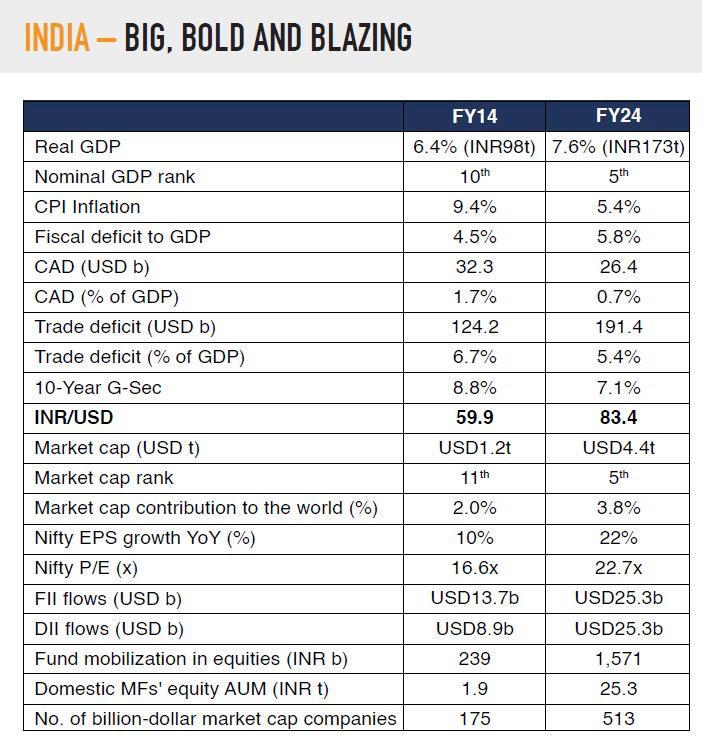
India appears well-positioned with several strong macroeconomic indicators, with real GDP growth surpassing expectations in FY24. The economy has shown remarkable resilience, including robust Gross Value Added (GVA) growth, manageable trade and fiscal deficits, inflation around 5% as of June 2024, strong corporate earnings, and a stable currency.


Gross Domestic Savings Rate: A positive development in India’s economic performance was the improvement in the gross domestic savings rate, which reached a nine-year high in FY24 as of May 2024. This increase was driven by higher household financial savings. If these savings are channeled into productive investments, they could support future economic growth.


Investment Cycle: The investment cycle is expected to continue with greater participation from the private sector, assuming no major shifts in global dynamics and risk appetite.


Corporate Profit to GDP Ratio: In 2024, the corporate profit to GDP ratio stood at approximately 5%, reaching a 15-year high as of March 2024.


Economic Outlook: The longer-term outlook for domestic growth remains positive but is well-reflected in near-term valuations.


Earnings Growth: We believe mid-teen earnings improvement is possible at a broad level. Recovery in international demand conditions and local rural recovery could provide additional upside. Moving forward, market performance may largely depend on earnings growth. Large Cap-oriented strategies such as Large, Flexi, and Multi Cap appear better positioned. In the thematic space, Banking & Financial Services look attractive due to relative valuations.


Mid and Small Cap Allocations: In line with the medium-term perspective, staggered allocations to Mid and Small Cap through a systematic route are advisable.

The #1 lesson every investor needs to learn

WHEN TO SELL A STOCK

Although Warren Buffett famously says that his favorite holding period is “forever,” there are occasions when you may need to sell off your investments. Buying a stock is only half the job done; knowing when to sell is equally crucial. Many investors excel at purchasing stocks but struggle with identifying the appropriate time to sell. This struggle often leads to missed opportunities for maximizing gains or minimizing losses.

1. You Made a Mistake in Your Investment:

Sometimes, despite thorough research, an investment may not turn out as expected. If you realize that your initial analysis was flawed or new information comes to light that contradicts your original thesis, it may be wise to sell the stock.

Example: Suppose you invested in Jet Airways (India) Ltd. based on its market position and growth potential. Later, you find that the company’s financial health is much worse than anticipated, leading to potential bankruptcy. In such a scenario, selling the stock would be prudent to avoid further losses.

2. A Better Opportunity Arises:

If a new investment opportunity presents itself that promises better returns or aligns more closely with your investment goals, it might be beneficial to reallocate your funds.

Example: Suppose you hold shares of WIPRO Ltd., but you notice that Tata Consultancy Services (TCS), a company with superior fundamentals, is getting listed. TCS shows strong growth prospects and potential for higher returns. Considering this, switching your investment to TCS could be a more strategic move. TCS was listed on 25/08/2004 and has since delivered significantly higher returns compared to WIPRO, as illustrated in the graph below.

3. The Company No Longer Has a Competitive Advantage (No More Moat):

A company’s competitive edge, or ‘moat,’ can erode over time due to various factors like increased competition, technological advancements, or regulatory changes. 

Example- Nokia was the first to create a cellular network in the world. In the late 1990s and early 2000s, Nokia was the global leader in mobile phones. However, the company overestimated the strength of its brand and believed it could arrive late to the smartphone race and still win. In 2008, one year after the first iPhone release, Nokia finally decided to compete with Android, but it was too late. Their products weren’t competitive enough.

4. The Stock Becomes Overvalued:

When a stock’s price exceeds its intrinsic value significantly, it may be overvalued. Selling overvalued stocks can help lock in gains and reduce the risk of a price correction.

Example: Suppose you invested in Indian Railway Catering & Tourism Corporation Ltd. (IRCTC) during its IPO. The stock experienced a significant price increase of 700% from2019 to 2021, resulting in a price-to-earnings (P/E) ratio exceeding 300 in October 2021, which was much higher than the industry average. This overvaluation could have been a signal to sell and realize your profits. Indeed, the stock subsequently corrected by 48% and only returned to its 2021 levels in May 2024, after 31 months.

P/E ratio of IRCTC post listing (2019-2024):

Shares of IRCTC post listing (2019-2024):

5. Change of Management

Leadership plays a crucial role in a company’s success. A significant change in management can affect the company’s direction and performance. If you lack confidence in the new management’s ability to steer the company, it might be a signal to sell.

6. Slow Growth

If a company’s growth slows down significantly, it might no longer align with your investment strategy, especially if you are focusing on high-growth opportunities.

Example: Suppose you invested in Bombay Dyeing & Manufacturing Company Ltd. because of its diverse business portfolio and growth potential. However, if the company begins to show prolonged periods of slow growth, it might be wise to consider selling your shares in favor of a company with better growth prospects. For instance, Bombay Dyeing’s revenue increased from ₹2325 crore in FY 2012-13 to ₹2674 crore in FY 2022-23—a mere15% increase over ten years. Additionally, the company has incurred losses in six out of those ten years, indicating a weak growth trajectory.

Shares of Bombay Dyeing (2014-2024):

Additionally, portfolio rebalancing is another reason to sell a stock. Over time, certain stocks in your portfolio may grow disproportionately, leading to an unbalanced investment strategy. Selling stocks that have performed well and reallocating the proceeds into other investments can help maintain your desired asset allocation and risk level.

Personal financial needs can also prompt the sale of stocks. Life events such as buying a house, funding education, or covering unexpected expenses may require liquidating some of your investments. In such cases, selling stocks can provide the necessary funds while still aligning with your long-term financial goals.

In conclusion, while holding onto stocks for the long term can be beneficial, it is equally important to recognize when to sell. Regularly reviewing your investments and staying informed about market conditions and company performance can help you make well-informed decisions.

MONTHLY MARKET UPDATE & OUTLOOK – MAY’24

NVIDIA's Meteoric Rise

NVIDIA, a leading name in the tech industry, has recently achieved a significant milestone by surpassing Apple to become the world’s second-largest company by market capitalization (for a brief period). This remarkable achievement reflects not only the company’s impressive stock performance but also its strategic positioning and innovative prowess in key technology sectors.

The stock is up 32 times in the last 5 years

The revenue & profits are up 5 and 10 times respectively in the last 4 years and are expected to increase by another 3X in next 3 years

Factors Behind NVIDIA’s Meteoric Rise

  1. Dominance in AI and Data Centers: NVIDIA has established itself as a powerhouse in artificial intelligence (AI) and data center markets. Its Graphics Processing Units (GPUs) are critical for AI computations, machine learning, and high-performance computing, making them indispensable for tech giants and researchers.

  2. Gaming Sector Leadership: The company’s roots in gaming remain strong, with its GPUs being the gold standard for gaming enthusiasts. The continued demand for high-performance gaming hardware has been a steady revenue stream.

  3. Strategic Acquisitions and Partnerships: NVIDIA’s strategic acquisitions, like Mellanox Technologies and Arm Holdings, have bolstered its technological capabilities and market reach. These moves have diversified its product portfolio and opened new revenue streams.

  4. Growth in Automotive Technology: NVIDIA is making significant strides in the autonomous vehicle market. Its DRIVE platform is a comprehensive solution for self-driving technology, attracting partnerships with major automotive manufacturers.

  5. Expansion into Metaverse and Omniverse: The company is also venturing into the burgeoning fields of the Metaverse and Omniverse. These platforms are designed for creating virtual worlds and simulations, positioning NVIDIA at the forefront of next-generation digital experiences.


    How Nvidia Makes Money

Picture of the month

Quote of the month

Winning at money is 80 percent behavior and 20 percent head knowledge. What to do isn’t the problem; doing it is. Most of us know what to do, but we just don’t do it. If I can control the guy in the mirror, I can be skinny and rich.


– Dave Ramsey

Economic Indicators Overview:


GDP: The Indian economy grew at a robust 8.2% year-on-year (y/y) in FY24, surpassing the advance estimates of 7.6% y/y.


Manufacturing PMI: India’s Manufacturing Purchasing Managers’ Index (PMI) in May 2024 remained strong at 57.5 (compared to 58.8 in April 2024), marking the 34th consecutive month in the expansion zone, driven by accelerating new export orders and job growth.


Services PMI: India’s services sector displayed strong growth in May 2024, registering a PMI reading of 60.2.


GST Collection: Gross GST collections stood at INR 1.73 trillion (+10% y/y) in May 2024, marking the 27th consecutive month of collections exceeding the INR 1.4 trillion mark.


Core Sector Production: The index of eight core sector industries accelerated year-on-year to +6.2% in April 2024, compared to a +6% increase in March 2024.


Industrial Production: Factory output growth, as measured by the Index of Industrial Production (IIP), decelerated to -4.9% in March 2024, compared to a growth of +5.7% y/y in February 2024, driven by positive y/y growth in three major sectors: Mining, Manufacturing, and Electricity.


Credit Growth: Scheduled Commercial Bank credit growth reached 19.54% y/y as of May 17, 2024, compared to a y/y growth of 15.42% observed on May 19, 2023.

Equity Market Overview:


BSE SENSEX: The BSE SENSEX remained flat in May 2024, registering a slight decline of -0.7%, in line with the NSE NIFTY index.


BSE Mid-cap and Small-cap Indices: The BSE Mid-cap and Small-cap indices outperformed the BSE Sensex, with performances of +2.3% and -0.1% respectively.


Sector Performance: Capital Goods, Power, and Metals were the top-performing sectors in May 2024, with gains of +11.2%, +6.6%, and +4.7% respectively. Six of BSE’s 13 sectoral indices ended the month of May 2024 in the green.


Net Foreign Institutional Investors (FII) Flows: Net FII flows into equities were negative for May 2024, amounting to -$3.15 billion.


Domestic Institutional Investors (DIIs): On the other hand, DIIs were net buyers of Indian equities, with net inflows of +$6.43 billion.


Fixed Income:


After a sharp rise in April 2024 due to global financial market repricing, Indian fixed income market yields eased by almost 15-20 basis points during May 2024. This easing was attributed to easing global yields, muted inflation, a record RBI dividend raising hopes of faster fiscal consolidation, and rising expectations of lower gross issuances.


Liquidity:

Banking system liquidity was tight during May 2024, averaging a negative Rs 1.5 trillion, compared to flattish liquidity in April 2024, which is typically a seasonally easy month.

Looking Ahead:

  • The outcome of the general election suggests a likely continuation of key policies related to development and reforms. Coupled with India’s strong fundamentals, resilient domestic demand, and supportive policies, this continuity may provide buffers against external shocks.


  • Economic Growth: We maintain an optimistic outlook for economic growth, as past reforms are poised to support future expansion.


  • Investment Cycle: The investment cycle is expected to progress, with increased private sector participation, assuming no major shifts in global dynamics and risk appetite.


  • Consumption Recovery: Rural consumption appears well-positioned for a recovery, supported by a low base, falling inflation, and expectations of above-normal monsoons.


  • Sector Rotation: Post-election results may lead to sector rotation based on valuations and relative growth prospects.


  • Earnings Growth: We anticipate mid-teen earnings improvement at a broad level. Future market performance is expected to be largely dependent on earnings growth.


  • Investment Strategies: Large Cap-oriented strategies, such as Large, Flexi, and Multi Cap, appear well-placed. In the thematic space, Banking & Financial Services seem attractive due to relative valuations.


  • Mid and Small Cap Allocations: For the medium term, Mid and Small Cap allocations should be approached in a staggered manner through systematic investment routes.

Achieve Your F.I.R.E: A Guide to Financial Independence and Retiring Early

What is F.I.R.E?


F.I.R.E stands for Financial Independence and Retire Early. This philosophy focuses on aggressively saving and investing to enable individuals to retire significantly earlier than the traditional retirement age (usually 60), achieving financial independence in the process.

How Can You Achieve F.I.R.E?

Here are some essential steps to help you on your path to F.I.R.E:

  1. Aggressive Saving: Aim to save around 70% of your monthly income. This aggressive savings rate allows you to accumulate wealth rapidly, paving the way for an early retirement.

  2. Frugal Spending: During your earning years, adopt a frugal lifestyle. Even if you can afford to spend more, the goal is to save and invest as much as possible, avoiding unnecessary expenses.

  3. Disciplined Investing and Planning: Invest your savings as early and for as long as possible to maximize growth. Careful planning and evaluation are crucial to ensure your investments align with your financial goals.

  4. Lower Risk Appetite: With a shorter time horizon for wealth creation, it’s important to manage risk wisely. Consider balanced investment strategies, such as hybrid funds, to protect your savings from high volatility.

  5. The Rule of 25: This rule suggests that you need to save 25 times your annual expenses to maintain your lifestyle after retirement. For example, if your annual expenses are ₹10 lakh, you should aim to save ₹2.5 crore (₹10 lakh x 25) to retire early.

  6. Post-Retirement Strategy: Achieving F.I.R.E is not just about accumulating savings; managing your finances post-retirement is equally crucial. Plan to withdraw no more than 3-4% of your savings annually to ensure your funds last throughout your extended retirement.


Although the FIRE method is a good way to achieve post-retirement financial freedom, it requires immense self-control and discipline. Despite the advantages offered by this unique financial strategy, it is essential to understand that the FIRE method may not be suitable for everyone.


For instance, if living frugally does not suit your lifestyle, adopting the FIRE approach may not be ideal. On the other hand, if you’re capable of saving and investing aggressively, you may consider adopting this strategy.

Modi 3.0: Three Sectors Set for Growth

The political landscape in India now exhibits a sense of continuity, which augurs well for policy stability and the nation’s development trajectory. The reaffirmation of the ruling party’s mandate signals a resolute path forward, ensuring that key economic policies and initiatives stay on course.

The BJP’s manifesto, branded under the vision ‘Viksit Bharat,’ outlines an ambitious plan to transform India into a developed nation by 2047, coinciding with the country’s centenary of independence.

Third term:

In its third term, the BJP aims to continue its reform agenda and complete unfinished initiatives. Prime Minister Modi has hinted at making significant decisions to accelerate India’s growth. He highlighted the current period as unprecedented, marked by increasing growth rates, decreasing fiscal deficits, rising exports, a reducing current account deficit, controlled inflation, and growing opportunities and incomes. These factors collectively contribute to poverty reduction.

Future reforms:

Future reforms are expected to focus on further digitalization and strengthening India’s role in global value chains. The BJP’s policy push towards manufacturing and exports is anticipated to continue, with an emphasis on supply-side reforms. These reforms include a transition to clean energy, increased spending on both digital and physical infrastructure, and targeted policy initiatives aimed at youth, the poor, women, and farmers.

  • Infrastructure

A notable aspect of the NDA’s governance has been its focus on infrastructure development, resulting in the doubling of highway lengths and an increase in the number of airports from 74 to 146.

BJP Manifesto: ‘We will focus on the modern road network, enhance rail and metro connectivity with new age trains and expanded networks, develop comprehensive EV charging stations, construct new airports and advance our telecom infrastructure with affordable 5G and innovative 6G technology, promoting ease of living for middle class families’

We will expand the railway network to increase capacity for passenger as well as cargo transportation. We have constructed 31,000 km railway tracks in the last ten years. We are now adding 5000+ km of new tracks every year and will continue to add new tracks at this pace for the next five years’

Key players: Ambuja, Ultratech, L&T, Jupiter Wagons, RVNL, NCC, BHEL

– This theme will continue to gain prominence. Prime Minister Modi has recently announced that the speed of implementing infrastructure projects will be accelerated manifold in the next five years to make India the third-largest economy in the world.

– Railways and highways are expected to remain top priorities on the government agenda, with related sectors like minerals and metals also projected to grow.

– In the third term, the government may export locally designed and manufactured Vande Bharat trains.

– Over the next five years, the railway network is set to expand rapidly with the addition of 5,000 kilometers of new track each year.

– The government has set ambitious targets for the transport sector, including developing a 200,000-kilometer national highway network by 2025 and expanding the number of airports to 220.

– Further, Vision 2047 plans to complete the construction of national highways by 2037, as robust road infrastructure can have a multiplier effect in the following decade.

  • Defence Sector

BJP Manifesto: ‘We will vastly expand domestic defence manufacturing and exports of Made in Bharat defence equipment. This effort will be facilitated by accelerating indigenisation in major air and land equipment’

Key players: Hindustan Aeronautics, Bharat Electronics, BEML, Mazagon Dock Shipbuilders, Bharat Dynamics and Garden Reach Shipbuilders and Engineers

– India’s defense sector is witnessing a significant export boom. In FY 24, the country recorded a stellar performance, with defense exports reaching a record high of Rs. 211 billion, marking a substantial increase over the past few years.

– With rising demand for defense equipment, technologies, and services, there are promising prospects for companies involved in defense production and technology development.

  • Energy:

Key players: GAIL, IGL, Mahanagar Gas, Gujarat Gas, NTPC. APL Apollo Tubes, Finolex and pipe manufacturers may benefit from government’s vision to convert households to PNG.

By 2032, the government aims to add only 80 GW of coal-based power capacity compared to 500 GW of renewable energy capacity.

The focus is on reducing petroleum imports and achieving energy independence by 2047.

The government should prioritize the development of energy storage infrastructures, such as battery energy storage and pumped hydro projects, to facilitate a smoother integration of renewable energies with the national grid.

The views expressed herein constitute only the opinions/ facts and do not constitute any guidelines or recommendations on any course of action to be followed by the reader. This information is meant for general reading purposes only and is not meant to serve as a professional guide for the readers

What we learned from Warren Buffett at the Berkshire Hathaway Meeting

Before diving into the highlights from the event, it’s worth noting some key facts about Berkshire Hathaway:

  1. Share Price: A single share of Berkshire Hathaway, valued at $620,000 (approximately Rs. 5.2 crore), is the most expensive share in the world.

  2. Cash Reserves: The company holds $190 billion in cash and cash equivalents, an amount greater than the combined cash reserves of all Indian listed companies.

  3. Daily Earnings: Berkshire generates almost $100 million daily.

  4. Global Ranking: Berkshire Hathaway is the sixth largest publicly traded company in the world.

 
And the credit goes to none other than Warren Buffett, who acquired a struggling textile company in the 1960s and transformed it into the giant it is today.

Earlier this month, we travelled to Omaha, Nebraska, to attend the Annual General Meeting of Berkshire Hathaway and listen to the investing legend, Warren Buffett, share his insights on investing and life.


The event was a profoundly insightful and motivational experience, attracting 30,000 attendees from around the globe, including notable figures like Bill Gates (Founder of Microsoft) and Tim Cook (CEO of Apple), as well as fund managers from some of the world’s largest hedge funds.

We met many investors who have made the pilgrimage to Omaha annually for the past 30-40 years. A lot of investors were keen to know more about India and its growth story.

From taxi drivers to business owners, everyone had praise for Warren Buffett in Omaha. Many were early investors in his company and have significantly benefited from his remarkable track record, which saw a single share of Berkshire Hathaway grow from $19 (in 1965) to $620,000 (approximately Rs. 5.2 crore) today. A police officer we spoke to mentioned that he was able to retire 15 years early thanks to Buffett’s guidance.

The meeting was scheduled for 8 AM, but eager investors began queuing outside the CHI Health Center as early as 4 AM to secure the best seats and catch a glimpse of Buffett. Each year, a 30-minute film is shown before the event starts. This year, the film paid tribute to Warren’s longtime friend and business partner, Charlie Munger, who passed away at 99 in Nov 2023.

Following the film, Buffett discussed Berkshire Hathaway’s financials and answered questions from investors, imparting his vast wisdom. Here are some of the key insights he shared:

Buffet on investing

 
  • Successful investing is all about having a few very big winners

  • If you understand businesses, you understand stocks

  • The power of compounding is the most underrated power in the world

  • Don’t try to time the market

  • The best time to sell a wonderful company is (almost) never

  • Apple is Berkshire’s largest holding and Berkshire is Apple’s largest institutional investor: Apple is a very high-quality business to Buffett and Berkshire plans to own it for a long time

  • The impact of AI on human society – both good and bad – is yet to be seen

  • The transition from fossil fuels to renewable energy will take time and currently, it’s not possible to transition completely away from fossil fuels

  • On the importance of asset allocation – maintaining $189 billion cash pile: “It wasn’t that people didn’t have money in 2008. It’s that they were paralyzed. And we did have the advantage of having some capital and eagerness even to act, and a government that, in effect, looked at as us as an asset instead of a liability.”

  • Getting extraordinary results in the long-term is not easy, but getting decent results is, if your behaviour is right

  • Distribution businesses are not wonderful businesses, but they can perform really well if there’s a great manager at the helm

  • Positive on India: There are unexplored and unattended opportunities in India

Buffet on life


  • Kindness is free

  • Buffett has signed the “The Giving Pledge, ”committing 99% of his wealth to philanthropy.

  • Biographies are a wonderful way to have conversations with great people from the past

  • Figure out who you want to spend the last day of your life with, and meet them often

  • Having the resources and the will to act when everyone else does not is a great advantage

  • If you’ve been lucky in life, help pull up others too

  • Always surround yourself with people you look upto and trust

  • He has read ‘The Intelligent Investor’ by Benjamin Graham at least five times.

MONTHLY MARKET UPDATE & OUTLOOK – APRIL’24

Starbucks is not just a coffee shop, and McDonald’s isn’t solely a burger-selling chain

When we think of Starbucks and McDonald’s, our minds typically conjure images of coffeehouses and fast-food chains. However, there’s more to these corporate giants than meets the eye. Their innovative business models redefine the traditional notions of their industries.

Starbucks:


As the foremost coffee purveyor globally, Starbucks commands unparalleled customer loyalty. This loyalty translates into a remarkable financial phenomenon: customers have effectively loaned the company a staggering $1.6 billion, interest-free. How is this possible?


The cornerstone of Starbucks’ success lies in its ingenious loyalty program, which contributes a substantial 44% to its revenue stream. Through this program, customers load funds onto their gift cards via the app, effectively providing Starbucks with capital for growth and development.


This achievement is particularly noteworthy when juxtaposed with the fact that over 3,900 banks in the U.S. hold less than $1 billion in total assets. With approximately 39,000 outlets worldwide and a continual expansion trajectory, Starbucks amasses increasing cash reserves over time.

McDonald’s:


While renowned for its hamburgers, McDonald’s is also adominant force in the real estate realm. Holding the title of ‘The World’s Largest Restaurant Company’, McDonald’s boasts a unique business model that emphasizes property ownership.


In its 2021 Financial Report, McDonald’s reported assets worth $41.9 billion in property and equipment, ranking it as the 6th largest public real estate company globally.


This strategy stems from a visionary concept introduced by Harry J. Sonneborn in 1956: McDonald’s would own the real estate upon which future franchises would be erected. Rather than solely profiting from supplies or royalties, McDonald’s Corporation became the landlord to its franchisees.


By acquiring properties and leasing them at considerable markups, supplemented by a percentage of each shop’s gross sales, McDonald’s transformed into a real estate powerhouse. Presently, McDonald’s generates revenue through strategic real estate maneuvers, with its subsidiary handling property transactions and collecting rents from over 40,000 locations across 100 countries.

Quote of the month

Don’t be afraid to take risks and embrace failure. That’s where the best opportunities often lie.


Luck plays a role in success but the harder you work and the more you prepare, the luckier you get.


-Jim Simons, Founder, Renaissance Technologies

Economic Indicators Overview:


Manufacturing PMI: India’s Manufacturing Purchasing Managers’ Index (PMI) remained robust at 58.8 in April 2024 (compared to 59.1 in March 2024), marking its 33rd consecutive month in the expansion zone. The acceleration in output and new orders underscores strong demand conditions.


Services PMI: India’s services sector displayed strong growth in April, registering a PMI reading of 60.8.


GST Collection: Gross GST collections reached INR 2.10 trillion in April 2024, marking a 12.4% year-on-year increase and the highest ever recorded. This concludes the twenty-sixth consecutive month of collections exceeding the INR 1.4 trillion mark, following the previous record of INR 1.87 trillion in April 2023. Rising compliance, increased formalization of the economy, uptick in domestic transaction volumes, and growth in imports have contributed to elevated tax collections.


Core Sector Production: The index of eight core sector industries decelerated year-on-year to -5.2% in March 2024, contrasting with a +7.2% jump in February 2024 (revised upwards from +6.7%). Six of the eight constituent sectors recorded positive year-on-year growth, with fertilizers and refinery outputs experiencing a decline.


Industrial Production: Factory output growth, as measured by the Index of Industrial Production (IIP), reached a four-month high in February 2024, with a rise of +5.7%, compared to a year-on-year growth of +3.8% in January 2024. This growth was driven by positive year-on-year growth in three major sectors: mining, manufacturing, and electricity.


Credit Growth: Scheduled Commercial Bank Credit growth stood at 19.01% year-on-year as of April 19, 2024, compared to a year-on-year growth of 15.92% observed on April 21, 2023.

Equity Market Overview:


The S&P BSE SENSEX saw a rise of 1.1% in April 2024, mirroring the trend of the NSE NIFTY index.


The BSE Mid-cap and Small-cap indices outperformed the S&P BSE SENSEX, boasting gains of 7.1% and 9.6%, respectively.


In terms of sectors, Metals, PSU, and Power emerged as the top three performers for the month, recording gains of 10.8%, 10.0%, and 7.7%, respectively. Eleven out of BSE’s 13 sectoral indices closed the month in positive territory.


Foreign Institutional Investors (FII) flows into equities turned negative for April 2024, amounting to -$1.3 billion, following a positive flow of +$4 billion in March 2024.


On the other hand, Domestic Institutional Investors (DIIs) remained net buyers of Indian equities, with investments totaling +$5.3 billion, compared to +$6.78 billion last month.


In the year-to-date 2024, Net Foreign Institutional Investors (FII) Flows stood at +$0.04 billion, while net Domestic Institutional Investors (DII) investments in the cash markets amounted to +$18.36 billion, surpassing Foreign Institutional Investors (FII) investments.

Fixed Income:


In April 2024, while yields in the Indian fixed income market experienced an uptick mirroring global trends, the increase in Indian Government Securities (IGB) yields remained relatively subdued.


Since the end of March, the G-sec yield curve fluctuated within a range of 15-20 basis points (bps), with a relatively muted impact on corporate bonds ranging between 10-14 bps across the curve. This is in contrast to global trends, where yields saw a broader increase of 20-40 bps following a repricing of global asset prices during the month.


The 10-year G-sec yield in April 2024 fluctuated between 7.10% and 7.23% before closing the month at a slightly higher rate of 7.20%. This marks a slight increase compared to March 2024 (7.05%), February 2024 (7.08%), and January 2024 (7.14%). The average 10-year term premia improved to approximately 13 bps during the month, compared to the previous month where it remained relatively flat.


Monetary Policy: In its April 2024 policy review, the Reserve Bank of India (RBI) opted to maintain the status quo on both policy rate and stance. Despite anticipating robust economic growth and a potential decrease in inflation for FY25, the RBI underscored several factors posing upside risks to inflation. These include food inflation, potential climate-related shocks, escalating geopolitical tensions, and fluctuations in crude oil prices.


Liquidity: Core liquidity, which comprises system liquidity combined with Government balances, experienced a decline from Rs. 2.4 trillion at the end of March 2024 to approximately Rs. 1.5 trillion by the end of April 2024. This decrease was attributed to several factors, including cash leakage resulting from heightened seasonal cash demand, actions undertaken by the Reserve Bank of India (RBI) such as interventions and forex swap maturities, and an increased Cash Reserve Ratio (CRR) provisioning requirement.

Looking Ahead:


India’s growth trajectory is poised to remain positive, bolstered by a convergence of favorable factors. FY24 witnessed robust performance across all market segments, with mid and small caps particularly thriving.


Despite global challenges such as geopolitical tensions and commodity price fluctuations, the domestic economy has demonstrated resilience. Various indicators, including robust power demand, recovering rural consumption, vibrant capital markets, increasing corporate investment, and external demand growth, have fostered a conducive investment environment, potentially propelling economic expansion.


A noteworthy aspect of India’s growth narrative is the uptick in capacity utilization, primarily driven by cyclical and capital-intensive sectors. This trend suggests that businesses are investing to meet the escalating demand within the economy.


While the overall outlook for India appears positive, valuations persist at elevated levels across the board, albeit with exceptions like Large Banks and select utilities and commodities. Elevated valuations, coupled with rising bond yields, contribute to a reduction in equity risk premium.


The ongoing election cycles in various countries may trigger policy shifts, potentially heightening volatility and uncertainty in the latter half of the year. Consequently, adopting asset allocation strategies becomes crucial for effective risk management.


Aligning asset allocation with investment objectives and risk tolerance is essential for optimizing risk-return dynamics. Asset allocation funds, which invest across multiple asset classes, can mitigate volatility and offer a more balanced portfolio mix.


From an equity standpoint, Large Cap-oriented strategies such as Large/Flexi/Multi Cap strategies seem well-positioned in the current scenario. Additionally, within thematic investments, the Banking & Financial services sector appears compelling based on relative valuations.

MONTHLY MARKET UPDATE & OUTLOOK – MARCH’24

Japan’s Nikkei 225 completes a roundtrip after 34 years

The Nikkei 225, an index encompassing the top 225 Japanese companies, has recently surged to levels not seen since 1989. This resurgence is noteworthy given the historical context surrounding the index’s previous peak.


On December 29, 1989, amidst Japan’s economic boom years, the Nikkei achieved an all-time high of 38,915. This period, spanning from around 1986 to1990, was characterized by significant economic growth. However, the subsequent downturn, often referred to as Japan’s “lost decades,” marked a prolonged period of economic stagnation.


The decline in the stock market in 1990 was precipitated by tightening monetary policies and stricter regulations on the real estate market. This downturn underscored the challenges Japan faced in maintaining its economic momentum.


Recent upswings in Japanese shares can be attributed to several factors. The implementation of a redesigned tax-free government stocks program for individuals, known as NISA, has played a role in bolstering investor sentiment. Additionally, there is optimism surrounding the prospect of the Japanese economy returning to a semblance of normalcy after years of deflation.


Furthermore, the Japanese market has benefited from gains in US tech shares, with particular attention drawn to the performance of chip giant Nvidia. This transpacific synergy underscores the interconnectedness of global markets and highlights the influence of external factors on Japanese equities.


In conclusion, the resurgence of the Nikkei 225 index reflects a convergence of domestic and international factors shaping the Japanese market. As we continue to monitor these developments, it is imperative to maintain a nuanced understanding of the underlying dynamics driving market trends.

Quote of the month

“The best way to measure your investing success is not by whether you’re beating the market but by whether you’ve put in place a financial plan and a behavioral discipline that are likely to get you where you want to go.”


“The essence of investment management is the management of the risks, not the management of the returns”


– Ben Graham, financial analyst, investor and professor (Father of Value Investing)

Economic Indicators Overview:


Manufacturing PMI: The India Manufacturing PMI surged to a 16-year high of 59.1 in March 2024, up from 56.9 in February 2024. This remarkable increase was propelled by a surge in output and new orders. Notably, the index was driven by heightened inflows from both domestic and export markets, signaling sustained robust demand trends.


Goods and Services Tax (GST) Collection: March 2024 witnessed gross GST collections of INR 1.78 trillion, marking an impressive 11.5% year-on-year growth and securing the second-highest collection ever recorded. This achievement also marked the twenty-fifth consecutive month of collections surpassing the INR 1.4 trillion mark, following the record collections of INR 1.87 trillion in April 2023. Factors such as rising compliance, increased formalization of the economy, a surge in domestic transaction volumes, and enhanced administrative efficiency have collectively contributed to this buoyant tax collection trend.


Core Sector Production: In February 2024, the index of eight core sector industries exhibited a robust year-on-year growth of +6.7%, outpacing the +4.1% jump observed in January 2024 (revised upwards from +3.7%). This growth momentum represented the fastest pace in three months. Notably, seven of the eight constituent sectors recorded positive year-on-year growth, with only fertilizers experiencing a decline.


Credit Growth: As of March 8th, 2024, scheduled commercial bank credit growth surged to 20.41% year-on-year, a notable acceleration from the 15.68% growth observed on March 10th, 2023.


Inflation: February’s Consumer Price Index (CPI) inflation rate dipped to a 4-month low of 5.09%, decelerating from 5.1% in January 2024. However, food inflation accelerated, reaching 8.66%. Meanwhile, Wholesale Price Index (WPI) inflation moderated from January 2024, with the February 2024 print at 0.20%, down 7 basis points from January 2024. Notably, WPI inflation remained positive for the fourth consecutive month.


Trade Deficit: Indian merchandise exports surged by +11.9% year-on-year to $41.4 billion in February 2024, while imports increased by +12.2% year-on-year to $60.11 billion. Consequently, the merchandise trade deficit widened by +12.91% to $18.91 billion as imports outpaced exports in growth rate.

Equity Market Overview:

  • In March 2024, the S&P BSE SENSEX witnessed a 1.6% rise, indicating positive momentum in the market.

  • However, the BSE Mid-cap and Small-cap indices didn’t fare as well, with performances of -0.01% and -4.54% respectively, underperforming the S&P BSE Sensex.

  • Among sectors, Capital Goods, Auto, and Metals emerged as the top performers, registering gains of +6.1%, +5.0%, and +5.0% respectively. Notably, six out of BSE’s 13 sectoral indices ended the month in positive territory.

  • Foreign Institutional Investors (FIIs) showed a positive sentiment towards equities in March 2024, with net inflows amounting to +$3.7 billion, following a modest inflow of +$0.4 billion in February 2024.

  • On the other hand, Domestic Institutional Investors (DIIs) continued to exhibit a bullish stance on Indian equities, with net purchases totaling +$6.78 billion, up from +$3.06 billion in the previous month.

  • In the calendar year 2024, while net Foreign Institutional Investors (FII) flows stood at +$1.08 billion, net Domestic Institutional Investors (DII) investments in the cash markets amounted to +$13.06 billion, surpassing Foreign Institutional Investors (FII) investments.


Fixed Income:

  • In its early April policy review, the RBI opted to maintain the status quo on both policy rate and stance, aligning with market expectations. While the RBI anticipates robust growth and a decline in inflation for the fiscal year 2024-25 (FY25), it emphasized the potential upside risks to inflation stemming from factors such as food inflation, climate-related shocks, escalating geopolitical tensions, and fluctuations in crude oil prices.


  • Core liquidity, comprising system liquidity and government balances, saw improvement from INR 2 trillion at the end of February 2024 to approximately INR 2.4 trillion by the end of March 2024. This enhancement was largely driven by RBI interventions and the maturity of forex swaps. Following a period of tight liquidity conditions throughout the second half of fiscal year 2023-24 (2H FY24), system liquidity eased in March, averaging around negative INR 43,000 crore (compared to an average negative of around INR 2.1 trillion in January 2024 and negative INR 1.9 trillion in February 2024), supported by robust government spending and inflows related to forex activities.


  • Fixed income yields remained range-bound throughout March 2024. The 10-year Government Securities (G-sec) yield responded to global cues, including movements in crude oil prices, US Federal Reserve policy decisions, and US treasury yields, fluctuating within the range of 7.03% to 7.10% during the month. The 10-year G-sec closed the month slightly lower at 7.05%, compared to 7.08% in February 2024 and 7.14% in January 2024. Additionally, the 10-year term premium remained relatively stable or showed marginal negativity.


Expectations of robust growth numbers, moderation in inflation and improving external balances provides RBI leeway to hold rate for longer, while assessing global uncertainty.

Events to watch out for in April 2024:


  • Q4FY24 Earnings Season: Beginning in April 2024, the Q4FY24 earnings season commences against the backdrop of a previous quarter that surpassed expectations. The Indian economy displays resilience, marked by cooling core inflation and promising growth projections. Recoveries in exports and demand could potentially lead to earnings that exceed expectations.


  • General Election Developments: Starting on April 19th, 2024, voting for the Indian General Elections will unfold over six weeks across seven phases. Market watchers closely monitor these elections as policy continuity and support hinge on the electoral outcomes

    .

  • Commodity Prices: In late March 2024, gold reached an all-time high, registering a nearly 10% increase in 2024. Factors such as central bank buying and expectations of rate cuts have contributed to this surge. Additionally, weakening US dollar and declining yields have bolstered commodity prices. Oil markets remain buoyed near five-month highs due to OPEC+ production cuts, coupled with strong demand outlooks from China and the US. Commodity markets serve as crucial indicators for global markets.


  • Positive Economic Indicators: The Indian economy continues to display strength supported by demographic advantages, policy reforms, and structural changes. Key leading indicators such as tax collections, industrial activity, and power demand remain robust. Moderating inflation and a potential increase in private sector capital expenditure are additional positive drivers.

  • Attraction for Global Investors: India is increasingly becoming a preferred destination for global investors due to favorable macroeconomic conditions, expectations of policy continuity, etc. This trend may lead to heightened inflows.

  • Elevated Valuations: While the broader outlook for India appears positive, valuations remain high overall, with exceptions observed in sectors such as large banks, select utilities, and commodities.